Tencent 2025 Annual Report: Full-Year Revenue Exceeds 750 Billion Yuan, Gaming Business Delivers Strong Growth, AI Drives Multi-Engine Expansion
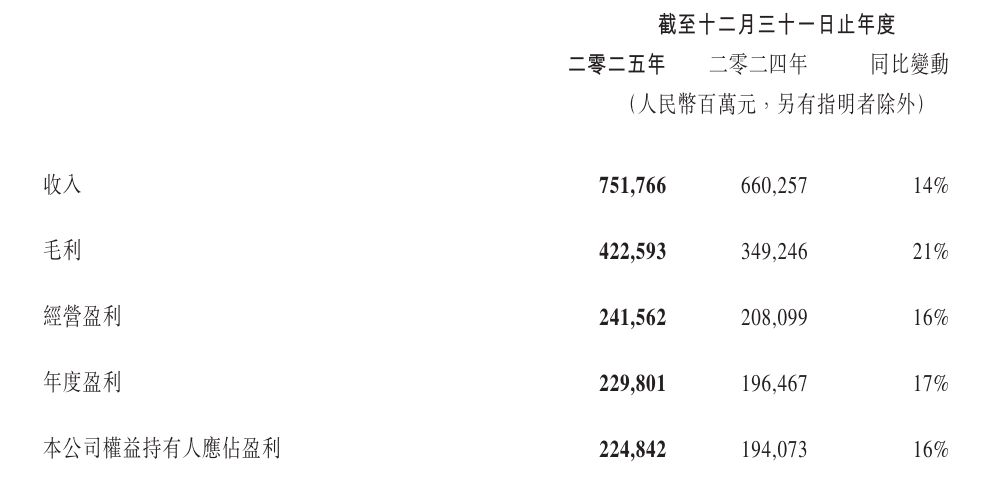
On March 18, Tencent Holdings released its full-year financial report for 2025. The results show total revenue of 751.766 billion yuan, representing a year-on-year increase of 14%, while profit attributable to equity holders reached 224.842 billion yuan, up 16% year-on-year, with multiple key metrics exceeding market expectations.
Against this backdrop of steady overall growth, the gaming business emerged as a major revenue driver. According to the report, Tencent’s gaming segment generated 241.6 billion yuan in annual revenue. Domestic gaming revenue reached 164.2 billion yuan, up 18% year-on-year, while international gaming revenue grew 33% to 77.4 billion yuan. Delta Force, Honor of Kings, Game for Peace, and the VALORANT series were cited as key contributors in the domestic market, while international performance was driven primarily by Supercell’s portfolio, PUBG Mobile, and Wuthering Waves.
Notably, the gaming business featured prominently in this year’s report. In its review of the year’s performance, Tencent’s opening statement noted that one of the drivers of healthy growth was “AI technology enhancing player interactions in games.” Among the highlights summarized, the top three all related to gaming: Delta Force becoming a new evergreen title, international gaming revenue surpassing $10 billion, and the deployment of AI in games accelerating content production and improving efficiency.
Gaming Business: Steady Domestic Growth, Accelerated International Expansion, with Both New Titles and Evergreen Hits Performing Strongly
In 2025, Tencent’s domestic gaming revenue reached 164.2 billion yuan, up 18% year-on-year. Key products highlighted in the report delivered strong results:
Delta Force emerged as a new growth engine, with DAU exceeding 41 million and steadily ranking among the top three on the iOS bestseller chart.
Game for Peace saw its DAU on Chinese New Year’s Eve surge from 80 million to 90 million. At GDC, Associate Game Design Director Xue Bing revealed that AI-driven gameplay features reached a peak DAU of over 17.7 million.
Arena Breakout mobile surpassed 10 million DAU, reflecting a broader resurgence across the shooter genre.
Honor of Kings, the VALORANT series, CrossFire, and League of Legends also maintained high engagement through version updates and cultural operations. CrossFire experienced a notable cultural phenomenon in 2025 with the rise of “Principal Culture,” driving a wave of returning players, while League of Legends saw a strong rebound in active users following the launch of its “Hextech ARAM” mode.
On the international front, Tencent’s overseas gaming revenue reached 77.4 billion yuan in 2025, up 33% year-on-year, surpassing $10 billion in annual revenue for the first time. Supercell’s portfolio and PUBG Mobile continued to perform strongly. In addition to contributing investment income, Wuthering Waves also benefited from Tencent’s AI capabilities, which supported its development and player experience optimization. Meanwhile, the long-running international title Warframe experienced a resurgence following operational adjustments.
Although 2025 was considered a “light year” in terms of new game releases, Tencent’s new product lineup still delivered notable results. According to a tally by Game Daily, Tencent launched approximately 20 new titles in 2025. Among them, VALORANT Mobile maintained a stable position in the top five on the iOS bestseller chart for most of its post-launch period. Titles such as Shengshi Tianxia, Path of Exile: Descent, Dune: Awakening, and NBA All-Star helped Tencent establish a foothold in new genres. Arena Breakout: Infinite, which expanded from mobile to PC, and Goddess of Victory: New Hope, which returned to the domestic market after its overseas debut, also generated significant attention.
AI Integration: From Technical Implementation to Commercial Monetization
This year’s report identified AI as a key driver of healthy business growth. Tencent Chairman and CEO Ma Huateng noted that the company’s healthy growth in 2025 was driven by AI technology, which enhanced ad targeting and player interactions in games, as well as accelerated revenue growth and scaled profitability in its cloud business.
Within gaming, AI applications have expanded from internal efficiency gains to external empowerment. Beyond deploying AI-powered gameplay features in titles such as Game for Peace, Tencent’s AI capabilities have also been extended to support the development and experience optimization of portfolio companies’ games, including Wuthering Waves.
Across the broader AI ecosystem, multiple Tencent AI products saw significant upgrades in 2025:
Tencent Yuanbao surpassed 100 million monthly active users, ranking among the top three AI-native applications in China.
AI workspace ima exceeded 13 million MAU, with over 420 million files stored in its knowledge base.
QQ Browser served over 130 million users through its AI features.
Sogou Input Method surpassed 100 million AI users, with mobile MAU reaching 670 million.
According to the report, Tencent’s R&D expenditure reached 85.75 billion yuan in 2025, while capital expenditure hit a record high of 79.2 billion yuan. Enterprise services revenue grew nearly 20% year-on-year, driven by surging demand for AI-related cloud services. Tencent Cloud achieved scaled profitability, with enterprise services revenue growth accelerating to 22% in the fourth quarter.
Hunyuan Model Upgrades and the “Lobster” New Species
During the post-earnings call, Ma Huateng devoted considerable time to discussing a product codenamed “Lobster.” He noted that while traditional chatbots require users to wait for responses, “Lobster” uses instant messaging to alleviate this waiting period. Unlike conventional chatbots, “Lobster” offers a more human-like experience, retains memory, and becomes increasingly aligned with users’ individual preferences.
“Every mini-program can be made intelligent and ‘Lobster-ized,’” Ma said. He noted that while WeChat is a centralized app, its ecosystem is decentralized, encompassing hundreds of thousands of active mini-program merchants, and exploring how to integrate decentralized AI applications into this ecosystem is a question worth pursuing.
At the same time, Tencent’s Hunyuan large model is approaching a major upgrade. During the March 18 media briefing, Tencent announced that Hunyuan 3.0 is scheduled for external release in April and is currently in internal testing. Over the past year, Tencent has implemented a series of organizational and talent adjustments around AI, establishing the AI Infrastructure Department, AI Data Department, and Data Computing Platform Department in December 2025 to strengthen its AI R&D framework and support continued iteration of the Hunyuan model.
These efforts have driven steady progress in the Hunyuan model’s capabilities. In December 2025, the Hunyuan 2.0 model was launched, delivering significant improvements in reasoning capabilities and efficiency. In January 2026, the Hunyuan Image 3.0 image generation model was integrated into Yuanbao, enabling text-to-image editing with a single sentence, which contributed to a 30-fold increase in daily AI image generation queries during the Chinese New Year campaign. In the 3D generation space, the Hunyuan 3D creation engine launched its international site in November 2025, with the model API also going live on Tencent Cloud International. To date, downloads of the Hunyuan 3D series have surpassed 3 million in open-source communities, establishing a broad user base among global developers and 3D creators.
Valuation and Shareholder Returns
Despite robust performance, Tencent’s valuation remains at a historically low level relative to its earnings. Based on the latest report, Tencent’s PE ratio stands at approximately 18x, below its historical average of 28x. By comparison, among the US tech giants, Google trades at around 29.6x, Meta at approximately 34.5x, and Amazon at around 32.5x. Among domestic tech peers, Alibaba trades at about 21.6x and Xiaomi at 22.7x. Given the 18% net profit growth in 2025 and the growth potential of its AI business, Tencent’s current valuation is considered to offer a reasonable margin of safety.
In terms of shareholder returns, Tencent repurchased and canceled 153 million shares in 2025, at a total cost of approximately HK$80 billion. The board has also recommended a final dividend of HK$5.30 per share. Including share buybacks, total shareholder returns for 2025 are expected to exceed HK$121 billion.
Conclusion
With steady growth in its gaming business, new opportunities emerging from AI, scaled profitability in its cloud division, and international gaming revenue surpassing $10 billion, Tencent’s 2025 annual report presents a picture of multi-engine growth.
During the post-earnings discussion, Ma Huateng remarked: “When designing things, everyone needs patience — good work takes time.” For a company navigating technological transformation and structural business evolution, perhaps the market, too, will need to exercise a similar degree of patience with a long-term perspective.
熱門頭條新聞
- Registration Opens for NVIDIA China Developer Day 2026 — A Premier Off line Tech Gathering for AI Developers in Suzhou
- Giving Back To The Industry: Nova Games Foundation Officially Launches To Empower Next Generation Game Creators
- Cozy Narrative-Driven Adventure Cat Secretary Launches on November 4th!
- Overwatch Rush Begins Soft-Launch in Southeast Asia, Blizzard Explores New Global Path for IP based Mobile Games
- GungHo to Shut Down Disney Pixel RPG on September 30, 2026
- Decorado: Alberto Vázquez on the Journey from Animated Short-film to Feature-length Animation
- CICF×AGF Guangzhou Anime-Game Festival: Greater Bay Area ACG Grand Event Lights Up National-Day Holiday
- Merge Mobile Game Sector Outlook 2026: Merge-2 Drives Robust Growth Amid Opportunities & Challenges