Japan Cartoonists Association Speaks Out on Disgraced Manga Artist Incident: “This Concerns the Credibility of the Entire Manga Industry”
Recently, a major scandal has shaken the Japanese manga world: a manga artist with a prior conviction for sexually assaulting a minor is suspected of having been “shielded” by a publisher, allowing him to change his name and continue serializing works, sparking massive public outrage. Several manga artists have announced they will no longer serialize their work on Shogakukan’s platforms to express their dissatisfaction with the publisher’s handling of the situation. On February 28th, the Japan Cartoonists Association officially issued a statement, emphasizing that this incident has seriously affected the credibility of the entire manga industry.
Origin of the Incident: “Ordinary Mask” Original Author Has Prior Sex Offense Conviction
The focal point of the controversy is the work “Ordinary Mask” (Original story by: Hajime Ichiro, Illustration by: Eri Tsuruyoshi), serialized on “Manga One,” a manga app under Shogakukan. On February 27th, the “Manga One” editorial department released a statement titled “Explanation and Apology Regarding the Suspension of ‘Ordinary Mask’ Distribution,” announcing the suspension of the work’s distribution and the shipment of its compiled volumes.
The statement revealed a shocking fact: the original author “Hajime Ichiro” of “Ordinary Mask” is actually Shoichi Yamamoto, the author of “Operation Fallen Angel,” who was previously arrested for sexual assault and subsequently fined.
The editorial department admitted in the statement: “In 2020, Shoichi Yamamoto was arrested, prosecuted, and fined, leading to the discontinuation of ‘Operation Fallen Angel.’ However, in 2022, the ‘Manga One’ editorial department began serializing a new work, ‘Ordinary Mask,’ credited to ‘Hajime Ichiro’ as the original author. We should not have hired him as an original author in the first place.”
The editorial department expressed deep reflection on this matter and offered sincere apologies to the victims, readers, illustrator Eri Tsuruyoshi, other contributing authors, and all related parties. The statement noted: “We take this matter seriously, acknowledging the problems that occurred in the decision to appoint the original author and the internal review system.”
Japan Cartoonists Association: “This Concerns the Credibility of the Entire Manga Industry”
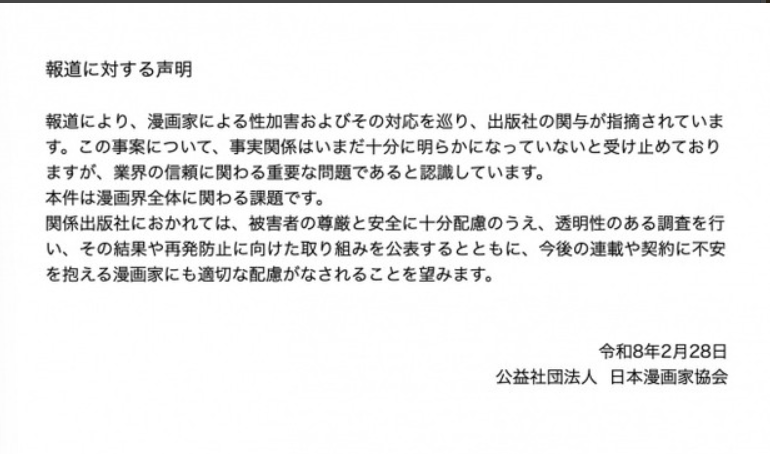
As the incident continued to escalate, the Japan Cartoonists Association officially issued a statement on February 28th, responding to the publisher’s suspected “shielding” of a sex offender manga artist.
The statement pointed out: “According to news reports, there are suspicions of serious mishandling by a publisher concerning the sexual misconduct of a manga artist. Although the full details of this matter have not yet been thoroughly clarified, we recognize that this is a grave issue that affects the credibility of the entire manga industry and is a significant课题 worthy of the attention of the entire manga community.”
The association emphasized in its statement that this matter concerns the entire manga industry and called on the publisher involved to conduct a thorough and transparent investigation, with full respect for the dignity and safety of the victims. It urged the publisher to disclose the investigation results and specific measures to prevent recurrence. Furthermore, the association expressed hope that the publisher would appropriately address the concerns of manga artists regarding future serializations and contracts.
Industry Turmoil: Multiple Manga Artists State They Will Not Renew Contracts
This incident has triggered a chain reaction within the Japanese manga industry. Several manga artists have publicly stated that, given the publisher’s handling of the disgraced author, they will no longer choose to serialize their works on Shogakukan’s platforms. This collective stance undoubtedly puts immense pressure on the publisher and prompts both industry insiders and the public to re-examine the social responsibilities and ethical底线 of manga publishing institutions.
Conclusion: Credibility is the Lifeline of the Industry
As a significant cultural export symbol of Japan, the manga industry carries not only immense commercial value but also bears extensive social influence. This incident exposes an imbalance between commercial interests and social responsibility within some publishing houses and sounds an alarm for industry self-discipline.
As the Japan Cartoonists Association stated, this matter concerns the credibility of the entire manga industry. In today’s era of high information transparency, any attempt to “shield” or “tacitly approve” of misconduct will ultimately backfire on the industry itself. How to uphold ethical standards while pursuing commercial success is a课题 that every publisher and every professional in the field needs to seriously consider.
熱門頭條新聞
- Evolution of Game Monetization Maps Global Investment Trends;
- Human Fall Flat Celebrates 10 Year Anniversary Alongside 60 Million Players
- Amazon MGM Studios Unveils Full ‘Warhammer 40,000’ Animated Series Project, Led by Henry Cavill & Blur Studios
- AEVI Releases 2025 Spanish Video Game Report
- The Stone Age Survival Game That Actually Has Color Is Leaving Early Access August 25
- Tiny Teams Festival Returns This August to Celebrate Micro Studios with Massive Ideas
- Two Flagship Industry Reports Unveil Critical Mobile Game Growth Barriers & Winning Strategies for 2026
- London Emerges as Europe’s Undisputed Mobile Gaming Powerhouse