Enterprise AI Spending Surges to $37 Billion
Enterprise AI Spending Surges to $37 Billion: Data Reveals Industry Boom, Not Bubble Hype
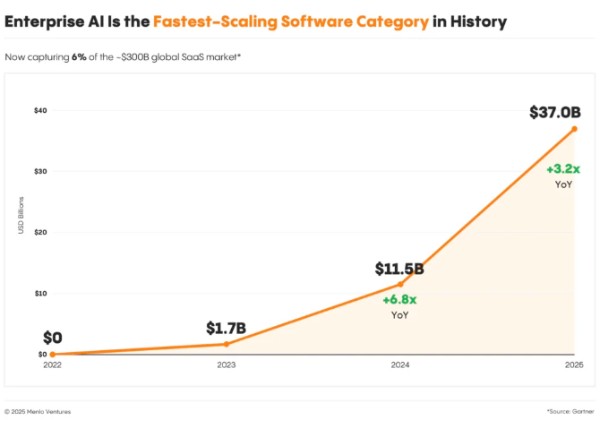
Despite ongoing market skepticism about over-investment and valuation bubbles in the artificial intelligence (AI) field, the latest industry data paints a distinctly different picture. A recent report from renowned venture capital firm Menlo Ventures shows that global enterprise AI spending has surged to $37 billion in 2025, making it the fastest-growing category in software development history. The report clearly indicates that this growth is driven by real demand, signaling that the AI industry is entering a phase of substantive prosperity.
Demand Growth Outpaces Hype Cycle
According to the report, enterprise AI spending has tripled from $11.5 billion to $37 billion within a year, strongly countering previous doubts about the high failure rates of generative AI projects. AI applications are accelerating their penetration across various functions such as programming, sales, customer service, and healthcare, moving beyond the proof-of-concept stage.
Notably, application-layer tools now account for a $19 billion market, representing over half of all generative AI spending and more than 6% of the global software market. This pattern of scaled adoption contrasts sharply with the false prosperity seen during bubble periods.
Shift to Procurement Model Accelerates Scalability
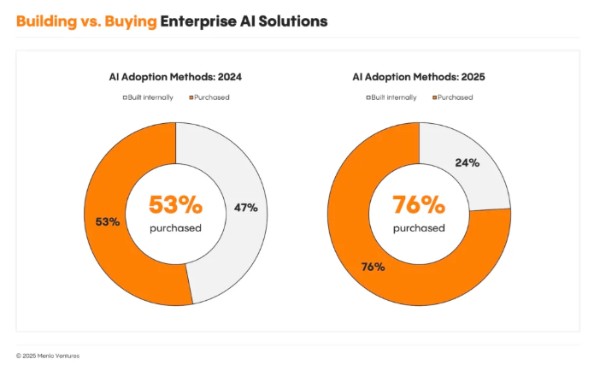
A year ago, enterprises were balanced between building and buying AI solutions. Today, 76% of AI use cases have shifted toward purchasing ready-made solutions, with companies preferring to rapidly achieve productivity gains through mature tools. Data shows that AI project conversion rates have reached 47%, nearly double that of traditional SaaS models, indicating more rational and efficient enterprise procurement decisions.
Bottom-Up Adoption Becomes Growth Engine
More compelling is the bottom-up nature of AI’s diffusion within enterprises. Product-led growth now accounts for 27% of AI application spending, while “shadow IT” (employee-initiated adoption) could push this proportion to 40%. Tools like Cursor and n8n gained traction among employees even before procurement departments intervened. This organic growth model differs significantly from the top-down enforcement seen during bubble periods.
Startups and Incumbents Leverage Respective Strengths
In the application layer, startups, with their rapid iteration capabilities, have captured a market share twice that of established vendors. Particularly in the programming tools sector, AI has fostered the first truly breakthrough category. At the infrastructure level, the market landscape is more balanced: mature data platforms like Databricks and Snowflake maintain a 56% market share, reflecting enterprises’ continued reliance on stable infrastructure.
Ongoing Reshaping of the Technology Landscape
Competition in the model market has shifted significantly. Anthropic, backed by Menlo Ventures and leveraging its technical advantages in programming scenarios, has surpassed OpenAI with a 40% market share to lead the enterprise large language model market. Google’s Gemini models have also grown their share, while the adoption rate of open-source models in the enterprise sector has dropped to 11%, indicating market consolidation around mature commercial solutions.
Infrastructure Investment Doubles
In 2025, enterprise spending on AI infrastructure—including foundational model APIs, training systems, and orchestration tools—doubled to $18 billion. Although autonomous agent concepts have attracted significant attention, their actual deployment remains limited, suggesting enterprises are advancing AI scalability pragmatically rather than chasing unproven technological concepts.
Menlo Ventures’ partners emphasized in the report: “Demand-side data tells a completely different story: widespread adoption, real revenue, and scaled productivity improvements—these signals collectively point to prosperity, not a bubble.” With Anthropic’s technological breakthroughs, the deepening of product-led growth models, and accelerated adoption in key sectors such as healthcare and finance, AI is expected to further demonstrate its practical value in 2026, continuing to drive industrial transformation and upgrading.
熱門頭條新聞
- 3rd NVIDIA DGX Spark Hackathon · Agent Skills Development Challenge
- Mai Shiranui arrives! Crystal of Atlan Launches the Fighter’s new class branch, Sugariff Alongside The King of Fighters ’98 collaboration character
- Crossing the Anime Frontier: Steam Anime Game Festival 2026 Kicks Off, Bringing Together Worldwide Anime-Style Games
- GATE ZERO FIGHTS TO PROTECT HISTORY IN FIRST COMBAT GAMEPLAY TRAILER – COMING TO STEAM AND CONSOLES SPRING 2027
- 78th Emmy Awards (Formerly Creative Arts Emmy Awards) Concludes, Honoring On-and-Behind-the-Camera Talents in Television
- Mr. RECORDS Brings the Beat to Nintendo Switch 2
- Blossom: The Seed of Life Goes Co-op with the “Together on Mars” Updated
- SlashZero Debuts New Story Trailer at PlayStation State of Play, Demo Available Now on PlayStation 5 and Steam