Chinese Animation Shines at “Animation’s Cannes”: From Ink-Wash Pioneers to Diverse Storytellers, Eastern Narratives Reshape the Global Animation Landscape
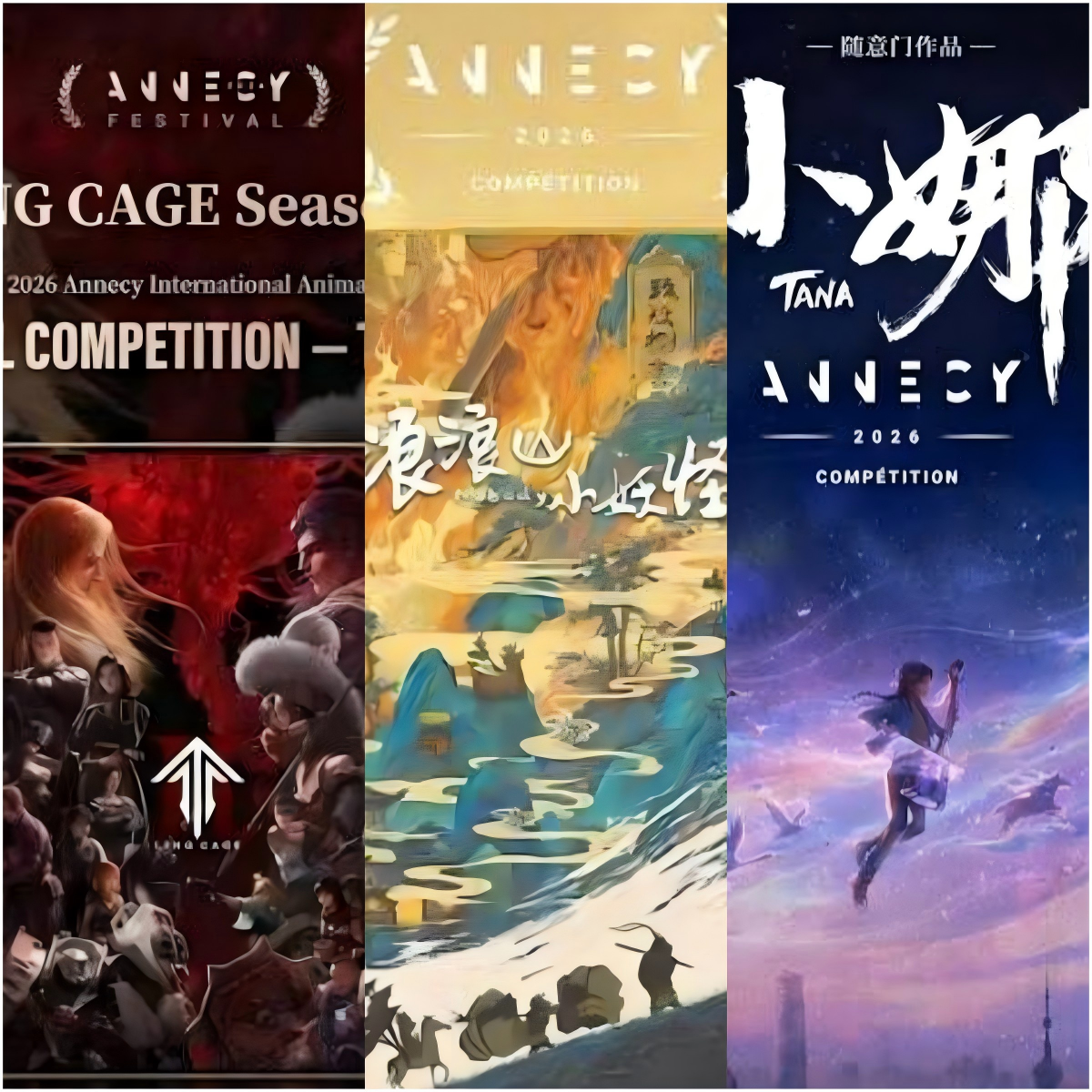
From June 21 to 27, 2026, the 50th Annecy International Animated Film Festival took place in Annecy, France. At this prestigious event—often hailed as the “Oscars of animation” and the “Cannes of animation”—Chinese animation achieved a historic milestone. Two Chinese animated features were simultaneously selected for the main competition lineup, four Chinese works secured spots across the festival’s core competitive categories covering features, TV series, and works-in-progress, and nine leading domestic organizations jointly operated a dedicated China Pavilion—marking Chinese animation’s definitive transition from “participant” to “competitor” on the world’s most prestigious stage.
From 1962 to 2026: A Sixty-Year Journey Comes Full Circle
Chinese animation’s connection with Annecy dates back to 1962, when Shanghai Animation Film Studio’s ink-wash animated short Tadpoles Looking for Mother—the world’s first ink-wash animation—won the festival’s Children’s Film Award with its groundbreaking artistic approach.
More than six decades later, the same studio returns to Annecy’s main competition stage with Nobody (Chinese title: Langlang Shan Xiao Yaoguai). This is no mere coincidence—it is a testament to artistic heritage. If Tadpoles Looking for Mother pioneered ink-wash aesthetics in animation, Nobody reinterprets that tradition for a new era. Produced over four years by a team of approximately 600 artists and technicians, the film comprises 1,800 shots and more than 2,000 scenes—demonstrating how a visual style once associated with handcrafted experimentation can now support large-scale feature production.
Directed by Shui Yu and adapted from the hit IP Yao-Chinese Folktales, Nobody continues the tradition of Chinese ink-wash aesthetics while centering on the growth and survival of ordinary beings. Released domestically in August 2025, the film earned 1.72 billion yuan (approximately $252 million) at the box office, becoming the highest-grossing 2D animated feature in Chinese history. Its international release has expanded to Australia, Malaysia, New Zealand, and North America, with particularly strong performance in Vietnam, where it has entered the top five highest-grossing Chinese-language films of all time.
Beyond Mythology: Contemporary Storytelling Takes Center Stage
Alongside Nobody in the main competition is Tana, co-directed by Ji Zhao and Ke Er Zhu. This 3D animation marks a decisive departure from the period epics and mythological narratives that have long dominated Chinese animation. It follows a young musician who returns from Shanghai to her native Inner Mongolia after being told her music lacks a “soul,” and gradually reconnects with her homeland, memories, and cultural roots through a mystical fiddle fairy.
Annecy Artistic Director Marcel Jean highlighted this evolution: “Chinese creators have increasingly focused on relatable storytelling while expanding the markets they aim to reach”. He further noted: “Tana is technically a very high-performing 3D animation, but also a story about parent-child relationships, about grief, that shows us something of contemporary China—something we’re not used to seeing in Chinese production”.
Two films, one clear trajectory: Chinese animation is no longer content with telling “Chinese stories” through “Chinese mythology”—it is now telling “Chinese experiences” through “universal emotions.” Regional specificity is becoming the greatest asset for global resonance.
Sci-Fi Breakthrough: Ling Cage Season 2 Makes History
This year’s Annecy also witnessed another milestone—the selection of Ling Cage Season 2, an original Chinese 3D sci-fi animation, in the main competition. This marks the first time a Chinese sci-fi animation has reached this level of international recognition at the festival.
Ling Cage Season 1 premiered on Bilibili in 2019, amassing 770 million views with a platform rating of 9.6 and a Douban score of 8.3, while sweeping more than ten major domestic awards including the Golden Dragon and Golden Monkey Awards. Season 2, launched in May 2025, has already surpassed 380 million views, pushing the franchise total past 1.15 billion, with a Douban score of 8.9 and an extraordinary 9.2 on IMDb—a new record for any Chinese animation.
Zhang Yi, brand director of Wuhan-based production house YHKT Entertainment, told Global Times: “This is a milestone that proves Chinese indigenous animation, especially in the heavy-industrial sci-fi genre, has closed the technological and artistic gap with the world’s best. It validates the leap from ‘following’ to ‘running parallel’ and injects real momentum toward the day we can ‘lead.'”
Season 2 contains more than 10,000 shots, with a dramatic leap in both the quantity and sophistication of visual effects. The creative team invented an entire proprietary language for the “Mana civilization” and choreographed fight sequences around authentic Eastern martial-arts principles. At the 2025 “Scientists’ Preview Screening,” rocket expert Li Duo publicly commended the mechanical structures and motion physics in Ling Cage for their scientific fidelity—evidence that China’s 3D animation industrial system has reached world-class standards.
Industry Goes Global: From Solo Efforts to Coordinated Offensive
If competition selections demonstrate Chinese animation’s “creative power,” then the China Pavilion at MIFA showcases its “industrial power.”
At this year’s MIFA, nine leading domestic organizations jointly operated a dedicated China Pavilion, covering content production, digital distribution, cultural IP, and industry events. Flagship studios including CCTV Animation Group and Zoland Animation presented original feature films and series to global distributors. Bilibili and Yuewen Literature hosted panels on “game narrative adaptation,” establishing cross-media IP pipelines spanning web novels, video games, and animated adaptations. The Palace Museum, the Golden Panda Awards Committee, and the China International Cartoon & Animation Festival (CICAF) organizing committee also participated, presenting traditional cultural IP adaptation resources to international partners.
The “From China to Global Animation Synergy” panel hosted by Bilibili brought together Chinese and international producers, distributors, and investors to discuss overseas release strategies, AIGC workflows, and cross-cultural adaptation, yielding over a dozen letters of intent on-site.
This “competition + market + forum” trinity model signals that Chinese animation’s global expansion has evolved from “occasional individual breakthroughs” to “systematic full-industry-chain outreach.” Chinese animation is no longer just being “seen”—it is being “partnered with.”
A Defining Moment: Chinese Animation’s Leap from “Following” to “Running Parallel”
In 2025, Chinese animation already made its mark on the global stage—Ne Zha 2 surpassed 15.9 billion yuan at the global box office, becoming the highest-grossing animated film worldwide; Nobody set a new 2D animation record with 1.72 billion yuan. The comprehensive breakthrough at Annecy 2026 now completes the picture, matching commercial success with artistic recognition.
Chinese animation is undergoing a triple transformation:
Narrative transformation: Expanding from the single track of mythological epics to a diverse spectrum encompassing contemporary humanism, sci-fi epics, and fantasy storytelling.
Technological transformation: From ink-wash experiments to heavy-industry 3D production, China’s animation system now stands shoulder to shoulder with world-class standards.
Industrial transformation: From solo efforts to coordinated global outreach, from “selling content” to “co-producing”—Chinese animation is claiming an increasingly proactive position in the global value chain.
As Annecy Artistic Director Marcel Jean observed, “Chinese creators have increasingly focused on relatable storytelling while expanding the markets they aim to reach”. When “Eastern aesthetics” and “global expression” converge on the Annecy screen, Chinese animation demonstrates not only its ability to decide “what stories to tell” but also its wisdom in “how to tell them”—telling stories rooted in Chinese culture in a language the world understands.
This, perhaps, is the key to Chinese animation’s journey from “following” to “running parallel”—and, one day, to “leading.”
熱門頭條新聞
- Annual Report of the German Games Industry 2026 published
- Woodland fantasy RPG Songs of Glimmerwick comes to Steam on September 30th!
- gamescom dev awards 2026 recognize outstanding indie games and industry contribution
- BOMBANANA! Set to Launch on 2 September 2026 on PC via Steam!
- Netflix Shuts Down Night School Studio and Moonloot Games, Restructures Gaming Division and Reshapes Its Entertainment Business Mix
- DCU Wonder Woman Reboot Gets First Official Update From Screenwriter
- Reborn · Stone Age Kicks off Second Reunion Closed Beta Test, Reviving a Pioneering Chinese Online Game Classic
- Chill Survival Adventure Until North Ends Launches in Early Access on August 31st