Three Shifts in a Decade: From Subway Surfers to Block Blast, How Mobile Gaming Conquered the World
From endless runners to user generated content platforms, from single player pastimes to social phenomena—the mobile gaming industry has undergone a quiet but profound power transition.
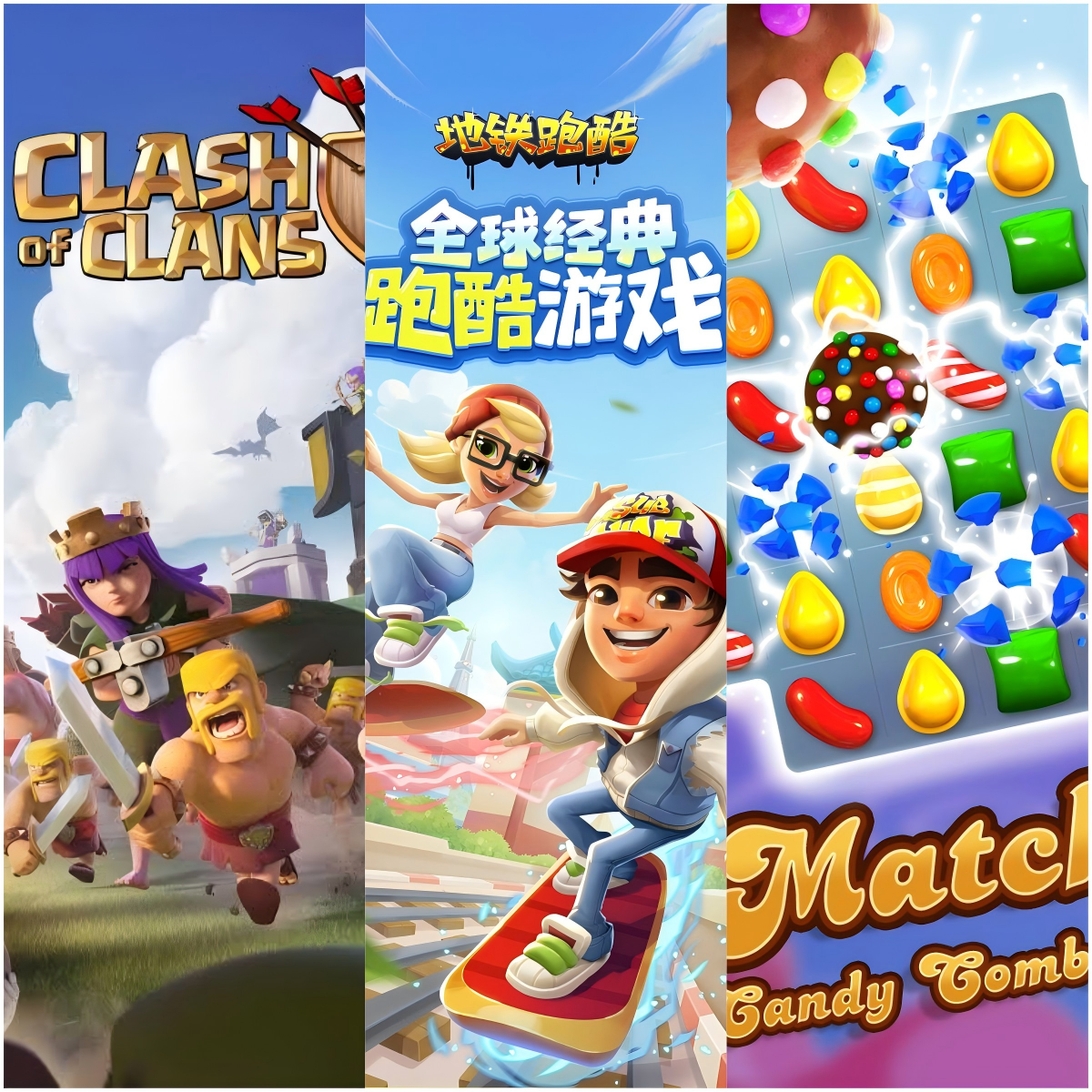
Looking back at 2015, the global mobile download charts painted a vivid picture: three endless runners—Subway Surfers, Temple Run 2, and Minion Rush—dominated the top spots, while Candy Crush Saga ruled the casual puzzle segment and Clash of Clans set the standard for strategy titles. These games shared common traits: single player focused, simple mechanics, easy to pick up but hard to master. Simulation titles like My Talking Tom precisely captured younger audiences, while the ultra minimalist Pou proved that even without any complex systems, a game could still attract tens of millions of players. At the time, multiplayer battles on mobile were still a niche, far from becoming the mainstream narrative.
Fast forward five years, and everything had been rewritten.
2020: the COVID-19 pandemic became the most unexpected catalyst for the mobile gaming industry. According to third party data, global mobile game downloads surged 73% year over year. The biggest winner was InnerSloth’s Among Us, originally released in 2018—overnight, this social deduction title went viral, amassing over 424 million downloads in 2020 alone. Meanwhile, Free Fire MAX and PUBG MOBILE catapulted the battle royale genre into the most dominant category on mobile, while Ludo King revived digital board games amid lockdowns. Hyper casual games also began to shine—titles like Hunter Assassin, Brain Out, Worms Zone.io, and Tiles Hop signaled that players increasingly preferred low commitment, instant gratification, pick up and play experiences.
Remarkably, Subway Surfers still ranked third on the 2020 download chart—nearly a decade after its original release. Consistent updates, seasonal events, and low device requirements helped it weather wave after wave of newcomers.
By 2025, the answer had shifted once again.
The download crown no longer belonged to a battle royale shooter. Instead, Hungry Studio’s puzzle title Block Blast! took the top spot with 368 million installs, comfortably outpacing perennial giants like Roblox and Free Fire. Roblox, in turn, is no longer a traditional “game” but a user generated content (UGC) platform, reflecting a deeper desire among new-generation players for co creation, social interaction, and long term immersion. Free Fire MAX held third, Subway Surfers remained fourth, while the collective rise of casual and “hybrid casual” titles such as Pizza Ready!, Vita Mahjong, and Hole.io confirmed a new industry consensus: lightweight, ad driven, and all-age-appealing gameplay logic had become the dominant paradigm. Interestingly, PUBG MOBILE slipped to tenth place on the 2025 download chart, signaling that the explosive growth of the battle royale genre had entered a stabilisation phase.
While downloads reflect shifting user attention, the revenue charts reveal the true commercial landscape.
The 2025 global revenue champion remained Tencent’s Honor of Kings, generating **$1.68 billion** in in app purchase revenue for the year—though slightly down from $1.74 billion in 2024, and with nearly all of that coming from its home market in China (the U.S. contributed only $8.5 million). Its dominance, however, remains unchallenged.
The real challenger was FunFly’s Last War, which earned **$1.57 billion** in 2025, a significant jump from $1.1 billion in 2024. Crucially, the game has not yet launched in mainland China—once approved, the 2026 revenue crown could easily change hands. Its top markets for 2025 were the U.S. ($672 million), Japan ($294 million), South Korea ($153 million), Germany ($58 million), and Taiwan ($40 million).
Roblox came in third with nearly $1.5 billion, up from $1.1 billion in 2024, no doubt fuelled by the viral success of “Grow A Garden” and “Steal A Brainrot” during summer 2025. It remains a distinctly Western, English speaking phenomenon—its top five revenue markets were the U.S. ($723 million), South Korea ($70 million), the U.K. ($66 million), Canada ($45 million), and Australia ($44 million).
Century Games’ Whiteout Survival also had a stellar year, rising from $936 million in 2024 to **over $1.4 billion** in 2025, with China contributing $377 million, the U.S. $325 million, and Japan $201 million.
Dream Games’ Royal Match saw a slight dip, from $1.39 billion in 2024 to **$1.37 billion**—partly because its companion title Royal Kingdom (which finished 35th with $246 million) may have diverted some attention with heavy user acquisition spending and celebrity ad campaigns. Scopely’s **Monopoly Go** also declined marginally, from $1.43 billion to **$1.36 billion** (noting that its web shop revenue is excluded from these figures), with its revenue overwhelmingly concentrated in the U.S. ($1.1 billion), followed by the U.K. ($48 million), France ($46 million), Canada ($35 million), and Germany ($31 million).
King’s Candy Crush Saga achieved a historic milestone in 2025—**crossing the $1 billion annual IAP revenue barrier for the first time**, up from $980 million in 2024. This decade old match three title consistently generated $75–90 million per month throughout the year, demonstrating remarkable longevity. Its market breakdown was again U.S. dominated ($576 million), followed by the U.K. ($54 million), Canada ($37 million), Germany ($37 million), and Australia ($23 million).
In the 9th to 20th positions: Pokémon TCG Pocket rode a strong launch wave, peaking at $94 million in March but fading to under $40 million monthly by year end, finishing outside the top eight. Coin Master suffered its third consecutive year of revenue decline, dropping from $697 million in 2024 to roughly $650 million.
The 11th to 20th bracket featured more newcomers and comeback stories: Microfun’s Gossip Harbor leaped from 55th to 11th ($550 million); Supercell’s **Clash Royale** jumped 38 spots to 13th ($453 million); Century Games’ second hit, Kingshot, launched in February and already reached 14th with $449 million—if momentum holds, a top ten finish in 2026 seems all but certain. Mihoyo’s **Honkai: Star Rail** fell from $562 million in 2024 to $423 million, while its sibling *Genshin Impact* dropped out of the top 20 to $335 million. Paper Games’ Love and Deepspace climbed ten places to 18th with $369 million. Tencent’s shooter **Delta Force** gained traction in the second half of 2025, finishing 21st with $355 million.
Also noteworthy are the downward trends: Brawl Stars reversed its 2024 recovery, plummeting from $626 million to just $271 million, falling 19 spots; Clash of Clans slid from $323 million to $254 million, landing in 33rd place.
Over the past decade, mobile gaming has completed a full circle evolution—from lightweight pastime to heavy social engagement and back to all encompassing casual entertainment. Technology, player behaviour, and business models have driven each other forward: more powerful hardware enables cross platform blockbusters; cloud gaming and AI open new frontiers; and user generated content platforms expand the very definition of gaming from “product” to “ecosystem.” Those titles that have successfully weathered multiple generations—Subway Surfers, Candy Crush Saga, Free Fire—all share a delicate balance of accessibility, continuous innovation, and long term player retention.
The next decade promises another wave of transformation. If the past ten years are any guide, the games that will prevail are those that combine ease of entry, relentless iteration, and the ability to keep players coming back—year after year. The race for attention, creativity, and commercial efficiency has only just entered its second half.
Hot News
- Registration Opens for NVIDIA China Developer Day 2026 — A Premier Off line Tech Gathering for AI Developers in Suzhou
- Giving Back To The Industry: Nova Games Foundation Officially Launches To Empower Next Generation Game Creators
- Cozy Narrative-Driven Adventure Cat Secretary Launches on November 4th!
- Overwatch Rush Begins Soft-Launch in Southeast Asia, Blizzard Explores New Global Path for IP based Mobile Games
- GungHo to Shut Down Disney Pixel RPG on September 30, 2026
- Decorado: Alberto Vázquez on the Journey from Animated Short-film to Feature-length Animation
- CICF×AGF Guangzhou Anime-Game Festival: Greater Bay Area ACG Grand Event Lights Up National-Day Holiday
- Merge Mobile Game Sector Outlook 2026: Merge-2 Drives Robust Growth Amid Opportunities & Challenges