AI Restructures Content Industry, Manga Dramas Become the Hottest Trend of 2026: Market Scale Aims for 20 Billion, Tech Giants Engage in Fierce Competition
Compiled by: CGGE Editorial Department. Please indicate the source when reprinting.
A revolution in the content industry driven by artificial intelligence is accelerating, and the first channel to be ignited is AI manga dramas. According to a deep-dive report released by Zheshang Securities on February 23rd, approximately 60,900 manga dramas were launched on the Douyin platform in 2025, with annual playback exceeding 70 billion views. Daily spending on promotion surged past 20 million RMB by December 2025. Institutions estimate that the manga drama market scale has already exceeded the 20 billion RMB level in 2025, a figure approaching half of China’s total box office revenue and is regarded the next phenomenal trend with the potential to surpass traditional short dramas.
AI Reduces Costs and Increases Efficiency: Production Costs Slashed, ROI Maximized
AI technology is fundamentally shaking the “production function” of the content industry. Data from Ocean Engine shows that AI shortens production cycles by one-third, boosts production efficiency by over 80%, and reduces production costs by more than 70%. Currently, about 60% of manga drama producers utilize AI tools, covering the entire process from script creation, storyboarding, coloring, and motion effects to dubbing and editing.
The industrial sample “Under the Immortal-Slaying Platform, I Shocked the Gods!” has become an industry benchmark: the 164-minute drama was completed by a team of just 12 people in 30 days. Upon release, it topped the Red Fruit dynamic charts, amassed over 100 million views by the end of January, achieved an impressive ROI exceeding 110, and maintained a user retention rate of 75%. Regarding production costs, traditional dynamic manga often costs over a thousand RMB per minute. AI technology compresses this to 1,000-2,500 RMB per minute, or even as low as 500 RMB. Production cycles shrink from months to 10-13 days, enabling a team of 6-8 people to handle the entire adaptation process for top-tier IPs.
Platforms Increase Support: Giants Accelerate Building a “Tools + Traffic + Monetization” Closed Loop
Since October 2025, platforms like ByteDance, Kuaishou, Tencent Video, Mango TV, and iQIYI have extensive introduced supportive policies, focusing on four key resources: revenue sharing incentives, AI tool access, shared IP elements libraries, and traffic distribution. ByteDance’s “Chenxing Plan” offers guarantees up to 5 million RMB per project, along with its “Jimeng” AI tool and access to the Tomato Novel IP library. Kuaishou’s “Inspiration New Era AIGC Venture Plan 2.0” uses cash and traffic rewards to attract both institutions and individual creators.
Official media are also accelerating their entry. On January 7th, China’s national streaming platform Yangshipin (CMG Mobile) released its 2026 boutique program lineup, announcing the “China AI Manga Drama Conference” and the “CMG First China AI Manga Drama Night,” along with plans to launch “The Classic of Mountains and Seas: Breaking the Chaos.” This signals formal mainstream recognition of the AI manga drama channel.
Technological Iteration Ignites the Industry: Seedance 2.0 Ushers in the “One-Person Crew” Era
The key variable on the supply side comes from leapfrog iterations in large models. ByteDance’s Seedance 2.0 and Kuaishou’s Kling 3.0 both underwent major updates in February, focusing on integrated multimodal input, generation, and editing. Seedance 2.0 adopts a unified multimodal audio-video joint generation architecture, supporting four input modalities: text, images, audio, and video. It integrates the industry’s most comprehensive multimodal content reference and editing capabilities, significantly enhancing generation quality.
A Bilibili UP-owner’s Pokémon animation generated using Seedance 2.0 caused a sensation on social media. Industry insiders commented that this breakthrough means “the era where everyone can be a director has officially begun; ordinary people can produce movie-quality work.” Zhang Zhihan, CEO of Daogu Culture, predicts that AI-generated photorealistic human dramas will completely eliminate the “AI feel” by the first half of 2026, leading to an explosion in production capacity.
AI-Generated Photorealistic Human Dramas Emerge, Targeting the Live-Action Short Drama Market
Since early 2026, a wave of short dramas featuring AI-generated “photorealistic humans,” represented by “Under the Immortal-Slaying Platform AI live-version,” has swept across major platforms. These works merged AI, cinematic language, and web novel IPs. Remade with a photorealistic style, they demonstrate a level of dynamic camera work, shot composition, lighting rendering, and particle effects comparable to traditional live-action productions.
Comments frequently seen on Douyin include “The special effects are explosive!” “I thought it was a real crew filming, turns out AI made it?” and “The micro-expressions are natural, the dialogue has emotion.” “Under the Immortal-Slaying Platform AI live-version ” was created by Miaoxiang producer in collaboration with the Kemeng AI platform. A 12-person team, a 30-day cycle, and 100,000 RMB in computing costs resulted in a highly impressive input-output ratio. Xiong Binghui, CEO of Kemeng AI, predicts that the growth in the 2026 micro-drama market will primarily come from AI-generated photorealistic human dramas.
Top-Tier Concentration Intensifies: Prompt Engineering and Directing Experience Become New Moats
Traffic is rapidly concentrating among leading industries. According to DataEye, total manga drama playback in 2025 reached 64.332 billion views, with the top 20 companies contributing 20.604 billion, or 32.03%. Moats are shifting from traditional production capabilities towards “prompt engineering” and cinematic directing experience. Complex productions demand highly skilled prompt design; leading companies are better positioned to attract such talent and are more familiar with storyboarding and narrative methods, resulting in more consistently high-quality output.
Differentiation on the profitability front is also widening. Currently, the ROI for purely payed manga dramas has dropped to 1.1, with only the top 5 companies achieving an ROI above 1.2. Facing high promotion costs and content homogenization, the industry is rapidly pivoting towards free models, relying on advertising and distribution for monetization.
IP-Driven Monetization Upgrades: Merchandise and Collaborations Begin to Unlock “Post-Linkage” Value
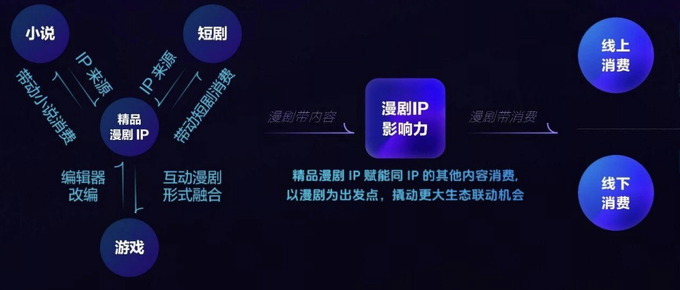
The commercialization path for manga dramas is evolving from a single revenue-sharing model to a multi-layered structure centered around IP. IP is transforming from a content source into a hub connecting content consumption, commercial conversion, and long-term value. In the past six months, over 60% of hit manga dramas originated from popular IP adaptations. Manga dramas guide users into consumption scenarios at climactic plots moments, creating a new content-driven monetization model.
typical samples are emerging: IF wines ‘s collaboration with “You Shan Ling” generated over 2 million RMB in GMV within two weeks of launch, selling over 30,000 units. “Wang Lanmei’s Happy Life” successfully relizating the gamification of its manga drama IP. Merchandise and brand collaborations are becoming new variables in monetization.
Overseas Expansion Window Opens: Short Dramas Validate Monetization, Manga Drama Supply Remains Scarce
The overseas market provides a clear reference for the going-out manga dramas. Data from Zheshang Securities indicates that overseas short drama app downloads reached 1.855 billion in 2025, a year-on-year increase of over 300%, with a market size of $4 billion, potentially exceeding $5 billion in 2026. Chinese companies dominate the monetization landscape. In-app purchase revenue in the overseas short drama market reached $2.279 billion in 2025, up 129% year-on-year, with Chinese going-out short drama apps contributing approximately $2.163 billion, or a staggering 94.93%.
However, manga drama going-out is still in its early stages. Currently, only 3 of the top 10 overseas short drama apps have launched manga drama sections or content. The production, promotion, and IP operation expertise of leading domestic companies have immense potential for scaled replication overseas.
Conclusion: From “Optional Choice” to “Compulsory Subject”
For content companies, AI restructuring is not an “optional choice” but a “compulsory subject” about survival. Overwhelming advantages in cost, efficiency, and user understanding are reshaping the competitive benchmark Players clinging to traditional production and distribution logic will find themselves not competing with rivals, but against the times themselves.
Data confirms that manga dramas have successfully validated AI’s restructuring ability. Top companies currently produce 30 titles monthly. Although still lower than the 100 titles for live-action short dramas, considering the industry only scaled kicked off in Q2 2025, the growth rate has far exceeded expectations. As large model technology continues to iterate, more content sectors—short videos, micro-dramas, games, film, and television—will undergo similar transformations. AI’s penetration is just beginning.
The next phenomenal hit might be just around the corner.
熱門頭條新聞
- Heritage and Renewal: Opening of Meiyingyuan-Shanghai Animation Space, Exploring Development Path for Chinese-language Animation
- Gun Fu action game SPINE comes to PC and consoles in Summer 2027
- THE WORMS ARE RETURNING IN A BRAND-NEW ADVENTURE IN WORMS: GALACTIC TACTICS
- Lexar Unveils Muse, the World’s Thinnest Portable SSD, at IFA 2026
- Unleash Your Inner Raccoon Menace: Dumpster Gang Announced for December Launch on PC.
- Chongbai Dreamery Officially Opens: Legacy Department Store Transforms into ACG Complex, Boosting Local-Business and Domestic-Animation Influence
- gamescom 2026: Record figures and top-level politics
- Maximum Entertainment Announces Hollywood Hustle, a Cozy Scavenger Adventure Through Hollywood’s Abandoned Backlots