Krafton’s Global M&A Strategy
 Source: https://store.steampowered.com/app/3251280/Rivals_Hover_League/
Source: Rivals Hover League on Steam
In recent years, Krafton has become one of the most prolific investors in gaming. Excluding Tencent’s megadeal with Ubisoft, Krafton has emerged as one of the largest and most active deployers of strategic capital in the industry during 2024-2025. And as sector venture capital/private equity dealmaking remains relatively muted (and Chinese strategics pull back), Krafton is more active than ever in investments and acquisitions.
But Krafton’s M&A approach is unique not just for its acceleration and scale, but for its motivations, which belie the company’s overall strategy. While acquiring new IP — a common goal for corporate development teams across the industry — is certainly one of Krafton’s key drivers, its dedicated focus on global markets and increasing moves toward nongaming media also differentiate it from its peers.
Diversification Through Expansion
Why is Krafton such a prolific investor? In short, Krafton is motivated by an intense need to diversify its business. About 80% of its revenue comes from the PUBG franchise, which itself is dominated by the PC flagship (directly operated by Krafton) and licensing revenue from Tencent’s mobile version. In 2022, PUBG Mobile provided 75% of Krafton’s entire revenue, which makes Krafton uncomfortably dependent on Tencent (one of Krafton’s own strategic investors).
Krafton is meeting the need to diversify in three ways. First, through diversification within PUBG. This includes operating Battlegrounds Mobile India (BMGI), new standalone titles in the franchise, and the introduction of UGC into the PC flagship. Some of Krafton’s India investments have a BGMI angle, but most of this effort leverages internal resources.
Second, geographic and IP expansion, particularly in India, Western countries, and, more recently, Japan. Placing small bets on a variety of talented game studios — mostly in the PC/console space — has been the bulk of Krafton’s deals over the years, with the goal of finding new major franchises to stand alongside PUBG. Krafton also has established new internal studios toward this objective, but with uneven success: The Callisto Protocol and InZOI are examples.
Krafton’s head of corporate development, Maria Park, described the rationale for external versus internal investment as “proactively investing in game studios [since] we believe that creativity cannot be easily taught, and so it better be discovered. And also while a big budget can help a team achieve high fidelity, we’ve learned over time that it does not necessarily guarantee a fun game.”

Source: https://krafton.com/en/games/inzoi/
Krafton’s latest major release, InZOI, came out earlier this year, and was covered by Naavik in April / Source: Krafton
Third, diversification by expanding beyond games. Krafton has pursued this strategy from the very beginning, investing in chatbots and digital storytelling platforms as early as 2021, but it has shown an increasing conviction (through larger check sizes) in recent years. While this approach obviously offers the highest degree of diversification, it comes with the biggest risks, both in terms of evaluating the quality of an investment opportunity in an unfamiliar market, as well as in managing a diverse portfolio to capture strategic benefit with the existing business.
Krafton’s 2024-25 Investments and Acquisitions
Krafton has been on an acquisition spree since its founding and from the beginning has looked beyond its core market for strategic investment opportunities. Some of its early acquisitions were in mobile gaming (despite PUBG’s PC roots) and in markets such as India.
The pace of Krafton’s investment has not slowed and if anything, has increased over time. In 2024, Krafton “made about 15 different investments and partnerships,” of which at least 10 were overseas game studios, paying between ₩2 billion to ₩12 billion (approximately $1.17 million to $8.65 million) for 15% to 29% stakes. The largest single investment, however, was outside of games entirely: an $89.3M check for 34% of Spoonlabs, a Korean audio livestreaming platform expanding into microdramas. In total, the company reported a total of ₩238 billion ($171 million) worth of shares acquired in “subsidiaries, associates, and joint ventures” over the course of 2024.
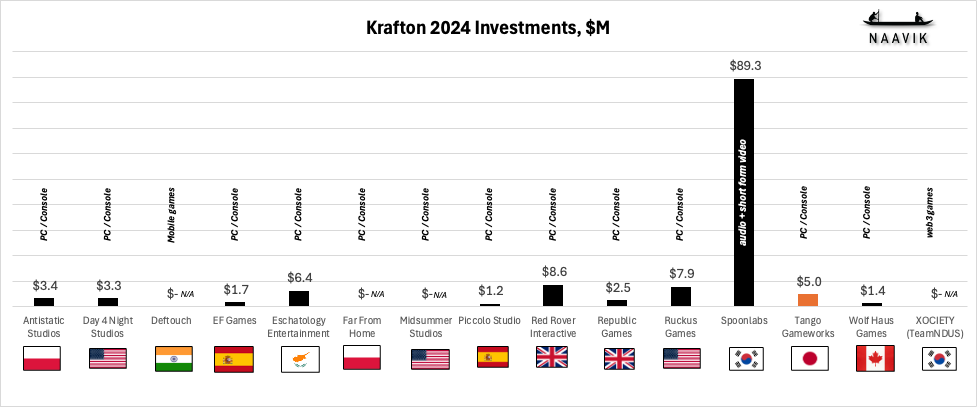
Source: https://www.krafton.com/wp-content/uploads/2025/05/2024_Separate_Financial_Statements_KRAFTON.pdf
Acquisitions are shown in orange. Krafton’s disclosed investments (in approximate USD value when converted from KRW) also include investing in venture funds, which is not included in this chart / Source: Krafton Financials
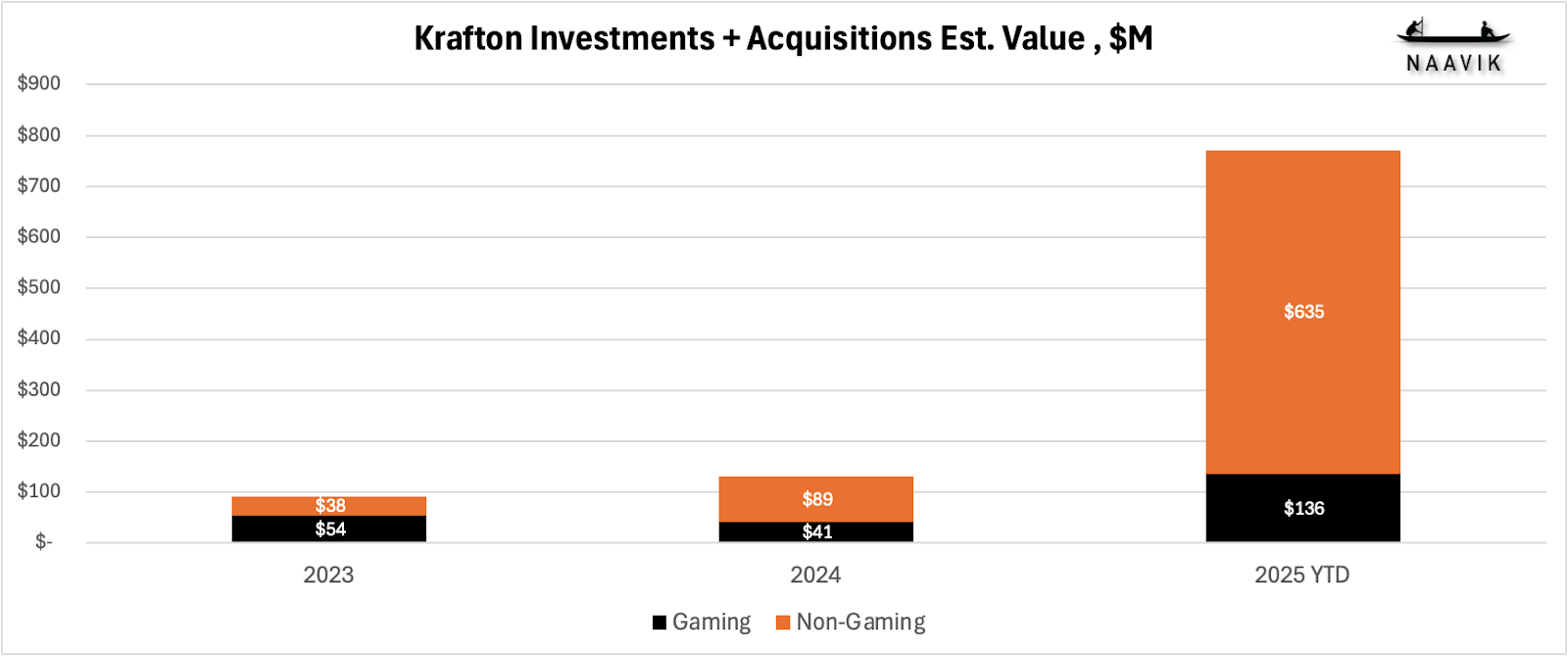
While Krafton invested less total capital in 2024 than it had in 2023, its strategic investments as a percentage of total private investment activity in gaming continued to climb in a chilly fundraising and acquisition environment.
Krafton has shared its plans to invest up to ₩1.5 trillion ($1.08 billion) in acquiring and developing new game franchises over the next five years. On average, this is $216M per year. From 2022-2024, Krafton invested an average of $181 million annually in gaming studios (excluding nonequity publishing deals), startups, and venture funds, slightly below its reported target. Krafton is a major LP in a number of gaming funds, such as 1Up Ventures, Lumikai, Bitkraft, Makers Fund, and the recently launched Blue Ocean Games, headed by Krafton’s former corporate head of investments Damian Lee.
Yet only midway through the year, 2025 is proving to be Krafton’s most active recent year by far, as its investment outlays have skyrocketed to at least $771 million, surpassing the three previous years combined by over $200 million.
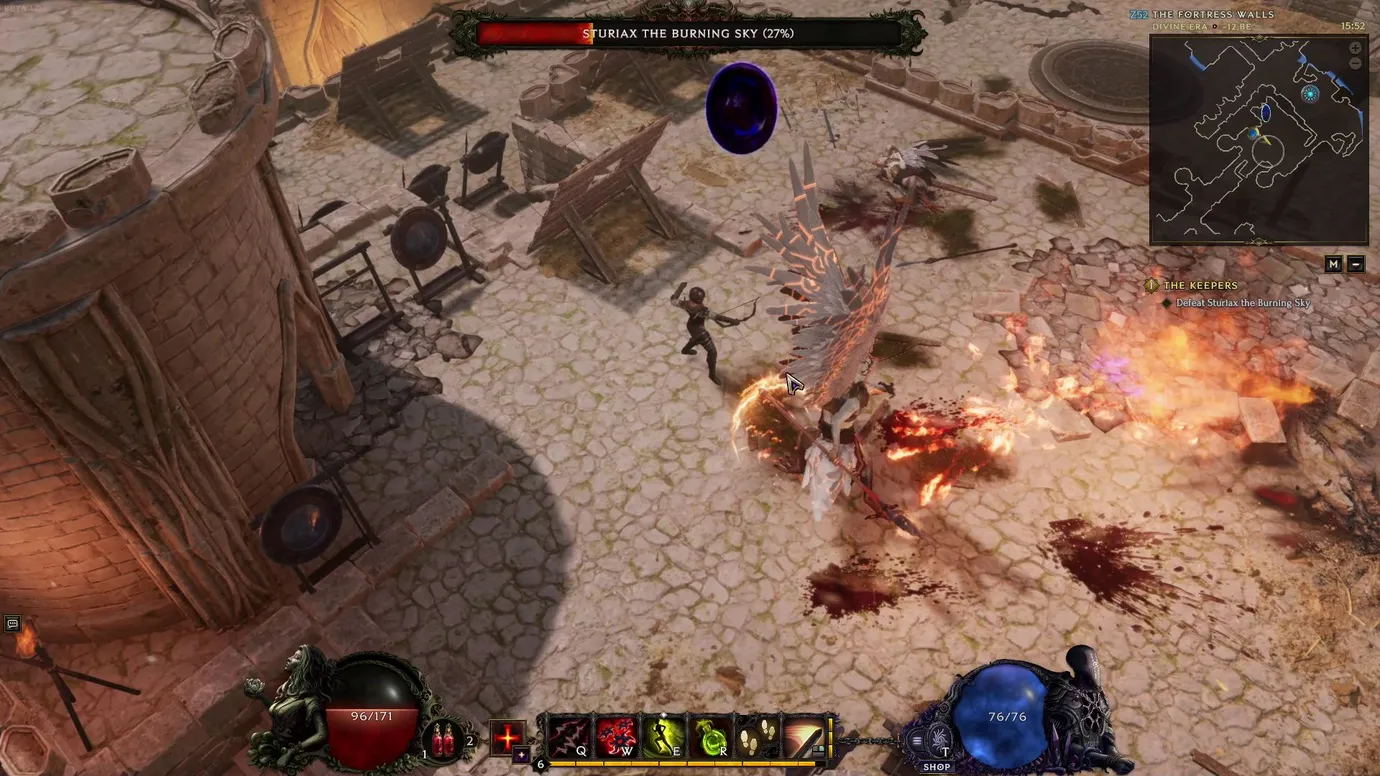
Source: https://www.rockpapershotgun.com/last-epoch-lays-out-plans-for-a-big-patch-this-week-and-new-end-game-content-later
Last Epoch, an MMO from Eleventh Hour Games, which was acquired by Krafton in 2025 / Source: Rock Paper Shotgun
Krafton has not yet disclosed the size of some of its investments this year, so the total year-to-date amount is actually even higher. In large part, 2025’s massive number is due to the full acquisitions of ADK, a Japanese animation studio, for $517 million, and Eleventh Hour Games, a U.S. game studio, for $96 million. In addition to its other announced deals, it has invested $26 million year-to-date in minority investments in game studios, including ArkRep and Coconut Horse.
2025’s portfolio differs from 2024 not just in size, but in composition. All but one of 2024’s 13 investments (including the unusual acquisition of Tango Gameworks after it was shut down by Microsoft) were PC/console studios (one of which was pursuing a web3 approach).
Krafton has made more diverse investments in 2025, which in many ways harks back to the wide variety of startups it supported in the past. In addition to PC/console studios, thus far this year Krafton has acquired or invested in four Indian startups (hyperlocal social media, a mobile sports gaming studio, an esports media firm, and a payments company), a Chinese gaming studio, a semiconductor software developer, and ADK.
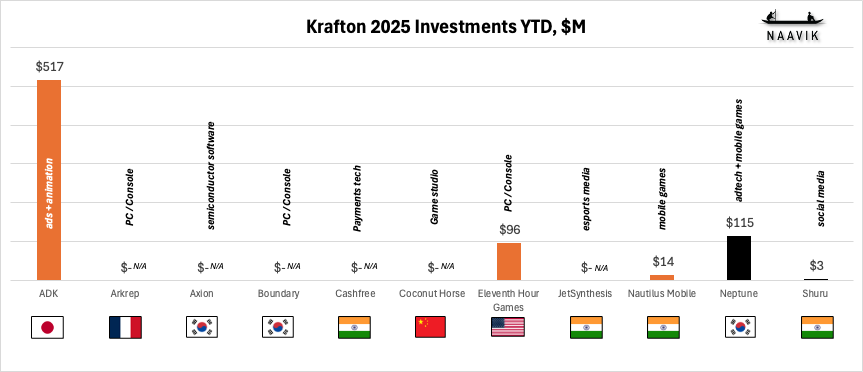
Source: https://www.krafton.com/wp-content/uploads/2025/09/KRAFTON-2Q25_Investor_Presentation_September_ENG_vF.pdf, https://www.techinasia.com/news/pubg-maker-krafton-acquires-japan-advertising-firm-adk-for-517m, https://www.crunchbase.com/acquisition/bluehole-acquires-adk-d6f5–4f32d9c4, https://techcrunch.com/2025/03/27/krafton-acquires-controlling-stake-in-indian-gaming-studio-nautilus-mobile-for-14m/, https://koreajoongangdaily.joins.com/news/2025-04-29/business/tech/Krafton-to-become-largest-shareholder-of-game-developer-Neptune-for-115M/2296602, https://economictimes.indiatimes.com/tech/technology/krafton-india-backs-hyperlocal-community-app-shuru/articleshow/121334456.cms?from=mdr, https://www.techinasia.com/news/pubg-maker-krafton-invests-in-indian-gaming-firm-jetsynthesys
Acquisitions are shown in orange. Krafton acquired 100% of ADK and Eleventh Hour Games, and “north of 75%” of Nautilus / Sources: Krafton, Tech in Asia, Crunchbase, TechCrunch, JoongAng Daily, The Economic Times, Tech in Asia
Investments Outside of Gaming
It is significant that in both 2024 and 2025, Krafton’s biggest external investments have been outside of gaming. ADK, acquired from Bain Capital this summer, represents Krafton’s most significant bet outside of its core gaming business, as well as its largest acquisition to date. What does Krafton want with ADK?
ADK comprises three divisions: ADK marketing solutions, ADK creative one, and ADK emotions. It is considered one of Japan’s “big three” ad agencies, as well as a premier producer of popular anime content and production services-provider to other anime firms. It has played a central role in developing some of Japan’s most popular IP, such as “Doraemon,” “Yu-Gi-Oh!,” and “Crayon Shin-chan.”
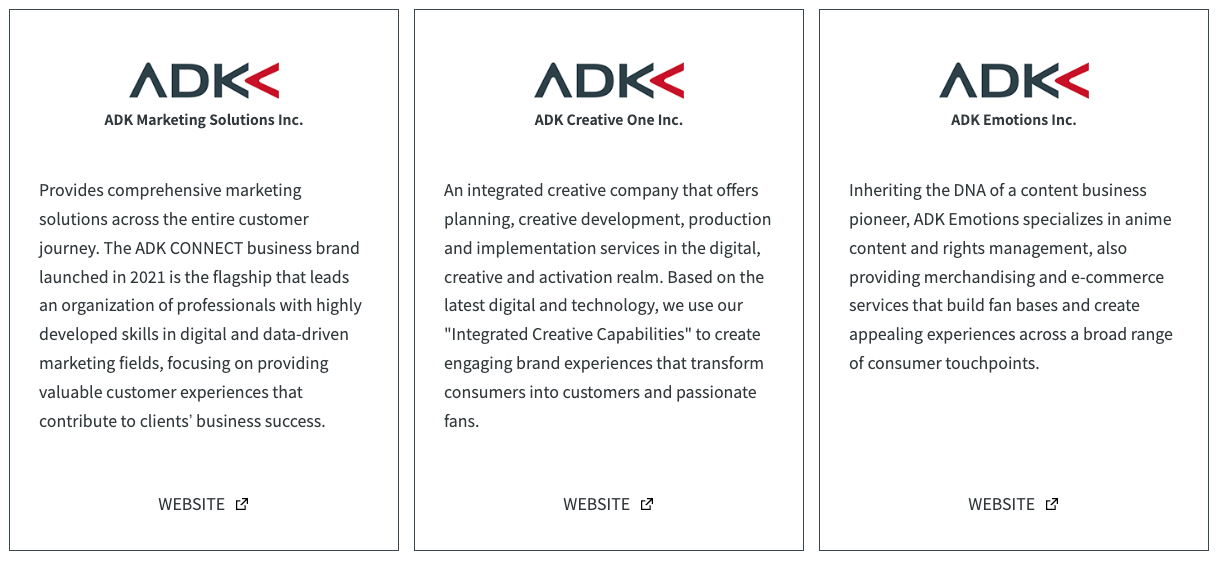
Source: https://www.adk.jp/en/about/outline/
Source: ADK Holdings
Acquiring ADK is synergistic with Krafton’s other expansionary activity in a few ways that mutually reinforce each other. First, it is the purest expression of Krafton’s desire to be a truly diversified entertainment company. As Krafton CEO Kim Chang-han said, “This acquisition is not just about expanding our content library. It’s about building a platform for storytelling that transcends mediums. We plan to leverage ADK’s rich legacy in animation and our expertise in global game publishing to create new forms of interactive IP.”
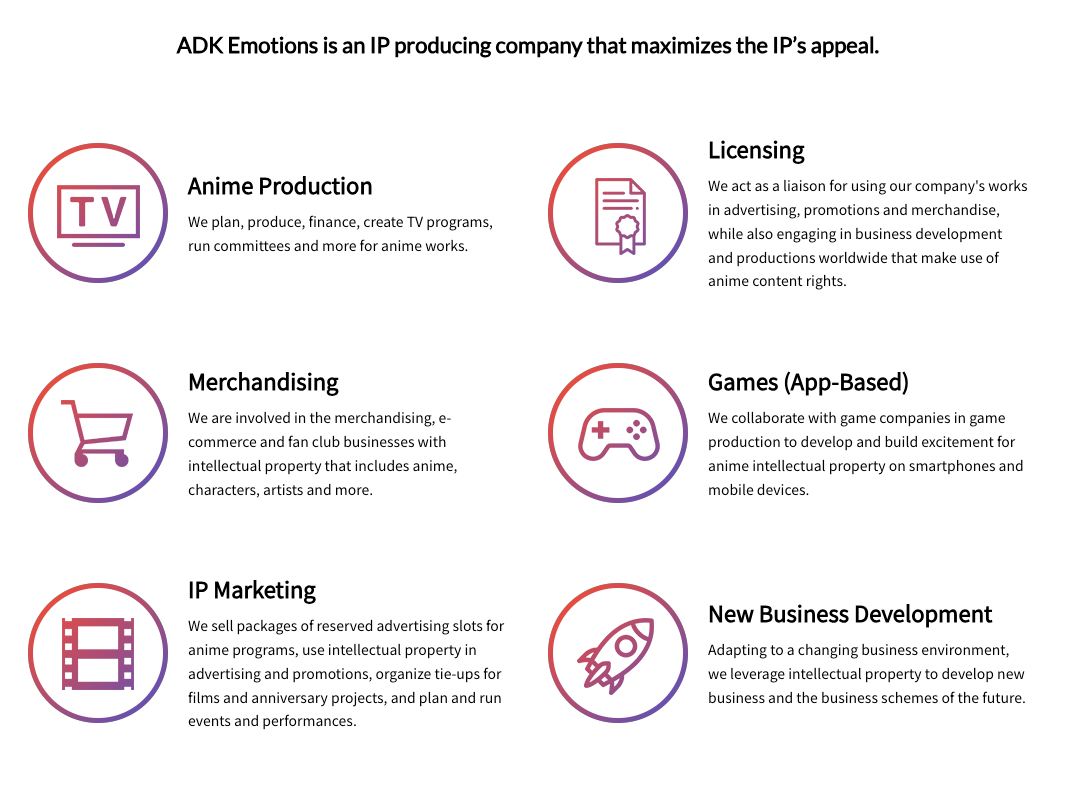
Krafton’s bread-and-butter investments in PC/console game studios represents its search for valuable IP in its core media format, while ADK is a well-oiled machine for scaling IP across new formats. As ADK itself describes on its website, its emotions division offers myriad ways to maximize IP appeal.
Source: https://www.adkem.jp/en/services/
Source: ADK Emotions
Second, the acquisition doubles down on Krafton’s presence in Japan, following the 2024 resurrection of Tango Gameworks, the studio behind rhythm-based action game Hi-Fi Rush. One of Krafton’s core pillars is serving global audiences, which it already does more than any other Korean gaming company. ADK offers a way to access the lucrative Japanese entertainment market across the entire spectrum of advertising, anime production, licensing, and more.
Third, Krafton has increased its activity in ad tech recently, becoming the largest shareholder in Neptune, a Korean ad tech and mobile gaming firm that offers services in ad optimization, rewarded ads, news curation, chatbots, and more. ADK complements these offerings by bringing in a large creative/agency business. Both ad tech and agency work offer their own lines of B2B revenue, and Krafton may be able to leverage both to boost its own IP at both a brand level and programmatically.
But there are risks to stretching beyond the core business. Last year’s marquee investment was in the Korean audio livestreaming platform Spoonlabs to back its own expansion into microdramas (through a new app called Vigloo). Vigloo’s performance has been underwhelming, with an estimated 284,000 MAU in August 2025 (less than 1% of market leader ReelShort), according to Sensor Tower.
Source: https://www.krafton.com/wp-content/uploads/2025/05/2024_Separate_Financial_Statements_KRAFTON.pdf, https://www.krafton.com/wp-content/uploads/2025/09/KRAFTON-2Q25_Investor_Presentation_September_ENG_vF.pdf
Krafton’s direct investments (not acting as a venture LP) since 2023. Total investment amounts have grown, while the share of capital directly invested into gaming companies has shrunk / Source: Krafton financials (2023-2024, 2025 YTD).
The ADK deal is a different beast altogether, of course, with increased upside and much greater risk. Unlike Spoonlabs, ADK is not a startup, but a large, diversified firm that is one of the largest in its regional market. Krafton also acquired the entirety of ADK, as opposed to the minority stake taken in Spoonlabs. And of course, ADK is in Japan, and Spoonlabs is based in Seoul.
While ADK may appear to offer more synergies to Krafton through IP collaboration and market access, it remains to be seen how a bold Korean gaming publisher will manage ADK, an established Japanese firm comprising three separate, mostly B2B companies outside of gaming.
The challenge of realizing potential synergies with ADK is immense. According to LinkedIn, Krafton has 1,600 employees, and ADK has a total of 2,300 employees across its companies. Will Krafton keep a hands-off approach and potentially forgo some of the upside of direct involvement, or will it manage ADK more actively, despite relative inexperience with the Japanese company’s market and business model? Time will tell. What seems certain is that Krafton will continue to invest aggressively to diversify its business away from PUBG — and leverage expansion outside of gaming to do so.
熱門頭條新聞
- Hand-Painted Cozy Adventure Seina: a Tale of Spirits Launches Free Steam Demo
- SPRAWL zero brings early 2000s nostalgia to PC and consoles this September
- Oops! You’re the Hero! steals its way onto PC September 15, 2026
- Bullet Heaven Cloudbreaker to Take Flight on September 15th — Will You Survive the Skies?
- Wuthering Waves Version 3.6 Lamplight in Mirage, Swords Resolve in Heart Out Now
- Rovio Revenue Stabilises Following USD 200M Impairment and Internal Restructuring;
- Annual Report of the German Games Industry 2026 published
- Woodland fantasy RPG Songs of Glimmerwick comes to Steam on September 30th!