Requirements for AI Ethics Governance in China

In 2017, the State Council issued the “Next Generation Artificial Intelligence Development Plan,” which called for the development of laws, regulations, and ethical standards to promote the development of artificial intelligence. Subsequently, a series of laws, regulations, and related provisions, such as the “Law of the People’s Republic of China on Scientific and Technological Progress,” “Regulations on the Management of Internet Information Service Algorithm Recommendations,” “Regulations on the Management of Internet Information Service Deep Synthesis,” “Interim Measures for the Management of Generative Artificial Intelligence Services,” and “Guidelines for Ethical Security Risk Prevention in Artificial Intelligence” have been enacted to regulate AI ethics governance. In 2022, the General Office of the Communist Party of China Central Committee and the General Office of the State Council issued the “Opinions on Strengthening the Governance of Science and Technology Ethics,” which is the first national-level guiding document specifically addressing science and technology ethics governance. It sets forth principles and basic requirements for science and technology ethics governance. In October 2023, the newly released “Measures for the Ethical Review of Science and Technology (Trial)” standardized the procedures, standards, and conditions for ethical review, marking a new stage in the construction of China’s AI ethics governance regulatory system. The following table summarizes the relevant laws, regulations, and their main contents related to AI ethics governance in China:

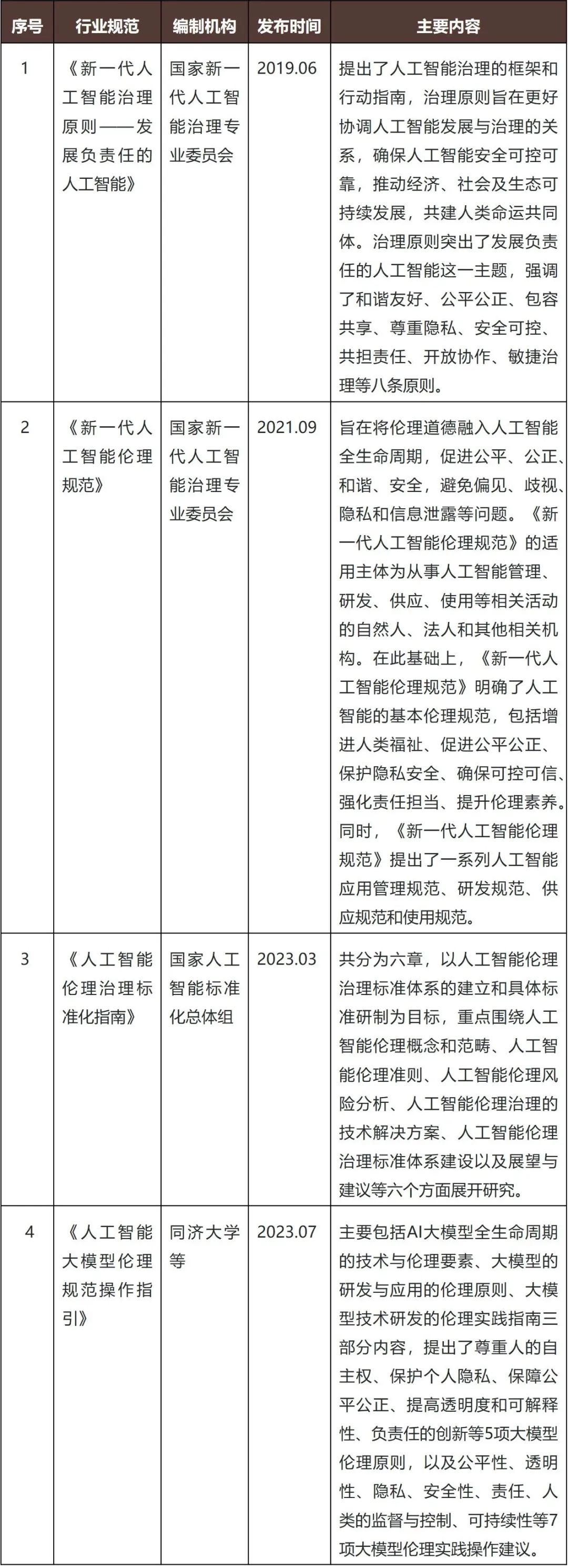
In addition to the aforementioned laws and regulations, under the guidance of policies such as the “Next Generation Artificial Intelligence Development Plan,” various institutions and industries have actively responded by issuing a series of industry standards related to AI ethics governance. These include the “Principles of Responsible Artificial Intelligence Development” and “Ethical Norms for Next Generation Artificial Intelligence” developed by the National Governance Professional Committee for Next Generation Artificial Intelligence, the “Guidelines for Standardization of AI Ethics Governance” developed by the National AI Standardization Overall Group, the “Operational Guidelines for Ethical Norms for Large-scale AI Models” compiled by the Research Team of the Tongji University Shanghai Collaborative Innovation Center for AI Social Governance, and the “Model AI Law 1.0 (Expert Draft)” prepared by the Research Group of the Chinese Academy of Social Sciences Major Project on Ethical Review and Regulatory System Construction of AI in China. These provide industry-specific recommendations for AI ethics governance. The following table summarizes the relevant industry standards related to AI ethics governance in China and their main contents:
熱門頭條新聞
- AI Man-Drama Enters “Licensed Operation” Era, Copyright Ownership Becomes Core for High-Quality Domestic Animation Development
- New European Animation Licensing Paradigm — Early-Stage Integration Fuels Long-Lived Animated Franchises
- Insight ’26 — Inaugural Post-Production & VFX Business Conference to Take Place in London
- Gods, Death & Reapers Gains Global Spotlight
- Yahoo Quietly Rebuilds Its Games Business: Daily Web-based Casual Games Open A New Growth Trajectory
- gamescom asia × Thailand Game Show 2026 Returns to Bangkok
- TIGA Submits Autumn Budget Proposals, Calls for Enhanced Video Games Expenditure Credit (VGEC) to Boost UK Games Industry
- Call for Entries Opens for FFAA 2027