2026 AI Manhua Series Trend Report: From Untamed Growth to Premium Positioning
AI manhua series have carved out a dedicated niche of their own, emerging from the broader micro-drama market.
Over the past year, a surge of creative series has emerged, including 2D and 3D AI manhua series, as well as AI-generated live-action-style dramas. This has led to 2025 being dubbed the inaugural boom year for AI manhua series, with the market reaching a value of 16.8 billion RMB. Market growth has accelerated the release of new AI manhua series, while audience demand continues to drive the evolution of AI tools. However, much like micro-dramas, AI manhua series, despite their considerable profit potential, face significant challenges.
The year 2025 marked not only the explosive debut of AI manhua series but also the most chaotic and untamed period for the entire micro-drama industry. Platforms were staking their claims, capital was flooding in, creators were finding their footing, and audiences were multiplying rapidly. Everyone felt the force of this wave, yet few could clearly articulate its full scope.
With the implementation of new regulations in April, AI manhua series have taken a significant step towards formalization. Their unique characteristic lies in the fact that they were never intended as niche content for a specific demographic. Benefiting from the vast content reach and highly sensitive recommendation algorithms of short-video platforms, AI manhua series have deeply permeated various age groups and urban demographics. Many users who never actively sought them out have naturally become their audience through consistent algorithmic recommendations.
In less than a year, this wave is transitioning from untamed growth to orderly competition. A trend towards premiumization is emerging, platform subsidy strategies are becoming standardized, teams of all sizes are finding their creative footing, and regulatory policies are gradually catching up. The year 2026 represents a critical juncture for the AI manhua series industry as it moves from a phase of explosive growth towards maturity.
- Definition and Characteristics of AI Manhua Series
The definition of AI manhua series is straightforward: they are video adaptations—using Artificial Intelligence Generated Content (AIGC) technology—of comics, online novels, or original stories, distributed on video platforms in serialized episodes, typically lasting between one and five minutes each. At their core, AI manhua series represent a new type of content product revolutionized by technology in terms of cost, efficiency, and scale. Compared to traditional animation, comics, or motion comics, their logic of production, distribution, operation, and promotion more closely resembles the micro-drama model that has gained immense popularity in recent years.
As a new content format straddling different categories, AI manhua series experienced rapid growth in the second half of 2025, garnering significant cross-industry attention. Their rapid development hinges on a combination of technological, market, platform, and capital factors: The iterative advancement of AIGC technology gradually enabled video generation, music/sound effects/voiceover, and crucially, character consistency. The continually lowering production barrier attracted a flood of producers. While micro-dramas entered a phase of viewer fatigue, the demand for quick, easily digestible entertainment content among users continued unabated. The distinct elements within AI manhua series—meme culture, novelty, visual gratification—have fostered a unique aesthetic culture for their audience. The collective entry of online novel copyright holders, coupled with a flurry of creative and traffic support policies from both short and long-form video platforms, has kept AI manhua series a hot topic in the content market.
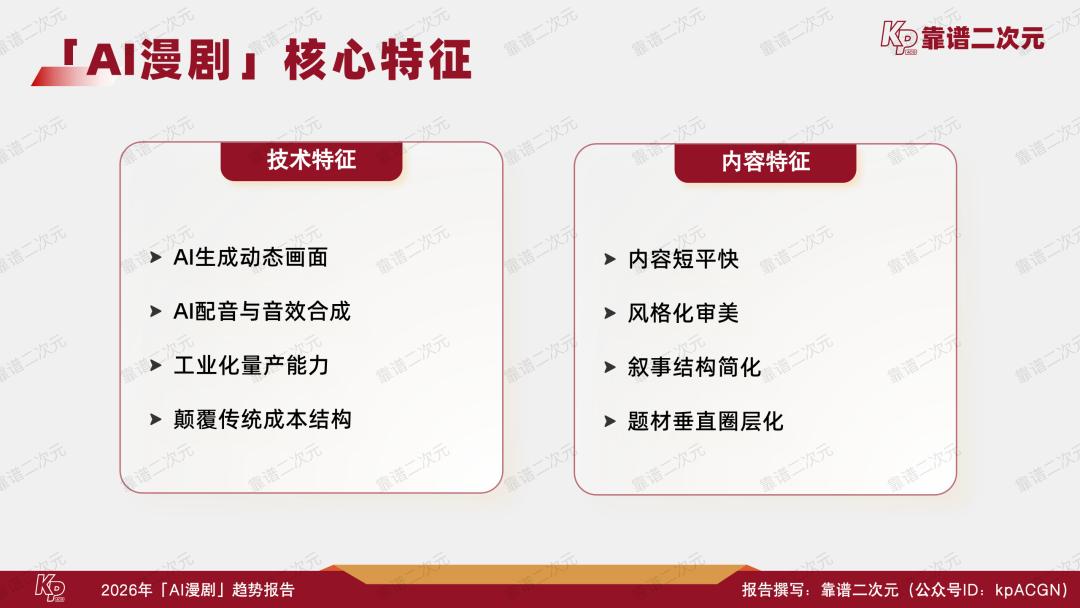
Analyzing from both technical and content perspectives, the core characteristics of AI manhua series are becoming evident:
Technical Characteristics: They enable a direct transformation from static to dynamic, from text to visuals. Creators input scripts and visual direction; AI handles the repetitive work of storyboard composition and scene rendering; humans oversee selection, refinement, and stylistic consistency; post-production tasks like motion effects, voiceover, and subtitles are integrated through automated pipelines. AI-generated voiceover is standard, automating audio-visual synchronization to create a unique immersive feel. Standardized processes and automated toolchains give AI manhua series an inherent capacity for industrial-scale production, upending traditional content cost structures and enabling large-scale, small-team, personalized content creation.
Content Characteristics: Still in an exploratory phase, the content is primarily short and fast-paced. Episodes are 1-5 minutes long, with a very rapid narrative rhythm and dense conflicts, catering to mobile users’ fragmented consumption habits. The creative style is characterized by distinct aesthetics, largely converging on categories like “Neo-Chinese,” “anime style,” and “photorealistic.” Narrative structures are simplified, mostly following classic three-act or episodic formats, with clear main storylines and simple, straightforward character relationships. Popular genres like “system,” “time-travel,” “rebirth,” and “apocalypse” are prevalent but are rapidly leading to intense competition with homogenized content.
2. Deconstructing the AI Manhua Series Industry Chain
The rapidly developing AI manhua series sector has attracted an increasing number of participants, forming a relatively complete industry chain with initial leading companies emerging in each segment.
Upstream IP Copyright Holders: Primarily online novel platforms, supplemented by a few comic companies and original authors, they provide story content and IP assets.
Technology Layer: Encompasses companies providing foundational AI large models and computing power (including cloud service providers), as well as production tools used in specific stages of creation.
Content Producers: One of the biggest variables in the industry’s development, this group includes studios, MCNs, and a vast, decentralized community of independent creators.
Video Platforms: The core drivers of industrial development, they manage marketing services and distribution channels, connecting content with the market. They control promotion, recommendation algorithms, operations, and advertising, significantly influencing a work’s traffic conversion, monetization model, and even its lifecycle.
Platforms hold three core powers: traffic distribution, commercialization rules, and content curation standards. In the early stages, they focused on rapidly expanding the content pool through subsidies and traffic incentives. Today, their approach has become more rational, shifting from minute-based blanket subsidies to a performance-oriented focus, placing greater importance on content metrics like completion rates and retention. Key platforms investing in AI manhua series include Hongguo Short Drama, Kuaishou, iQIYI’s Manhua Channel, and Tencent Video’s Fire Dragon Manhua.
Leading content producers are evolving from studios into highly process-driven content factories. By achieving stable output and partnering with platforms or IP holders, they are transitioning towards an “OEM + Co-production” model. Key producers include Jiangyou Animation, Xinghuo Animation, and ChineseAll.
AI manhua production tools and large models are starting to define the upper limits of style and lower limits of cost. Differences in model suitability directly impact visual quality and create new technical barriers. Commonly used tools include Kling, Jimeng, Jurilu, Tongyi Wanxiang, and Hunyuan large models.
Market feedback indicates that most hit AI manhua series are adapted from online novel IPs rather than original stories. IP holders are gradually gaining leverage in negotiations; low-cost licensing deals are diminishing, being replaced by models like “minimum guarantee + high revenue share” and “deep co-development.” Currently, key copyright holders in the AI manhua market include major online novel platforms such as Yuewen Group, Tomato Novel, Zhihu, and Qimao.
3. Market Status and Annual Insights
From 2025 to 2026, the AI manhua series market continues to grow and has entered a phase of explosive expansion. Aggregating data from multiple institutions, the size of China’s AI manhua series market in 2025 was estimated between 15 and 20 billion RMB, with projections to potentially exceed 30 billion RMB in 2026. Over 100 million users watched AI manhua series in 2025, a number expected to double in 2026, while the overall volume of productions is forecast to maintain rapid growth.
User Demographics: AI manhua series are breaking out from niche circles. Thanks to the recommendation algorithms of short-video platforms, users are frequently captivated by precisely targeted AI manhua series as they scroll, gradually becoming dedicated audience members. The audience base has expanded from early adopters of short dramas and short videos to a wider range of anime, comic, and online novel fans, penetrating from lower-tier cities to urban white-collar workers, students, and even middle-aged users. This extends consumption scenarios from fragmented entertainment to emotional companionship and stress relief.
Supply Side: The creative ecosystem is flourishing with increasing division of labor. The number of creators and works on mainstream platforms has grown exponentially. Numerous companies and teams from traditional animation, advertising, and online literature sectors have entered the space, driving the surge in AI manhua series content in 2025. Social media is active with many new and aspiring independent creators, with producing AI manhua series becoming a popular entrepreneurial path. The internal structure of creative teams is also evolving, from individual creators and pioneering companies to MCNs, film/TV companies, micro-drama studios, animation studios, and copyright holders forming dedicated AI manhua teams. As entrants bring expertise from their original fields, the visual styles of AI manhua series are diversifying significantly.
Platform Perspective: Video platforms and technology providers play a crucial role in fueling the AI manhua craze. Competing for user engagement, major platforms are investing heavily in supporting manhua content, quickly making it a vital component of their content ecosystems. Following the spin-off of Hongguo Short Drama’s “Hongguo Manhua” app, several independent manhua apps emerged. However, for major players, this is largely a defensive strategic positioning. Platforms are refining their support policies, shifting from broad traffic subsidies to targeted incentives for high-quality content and innovative styles. They are also engaging more deeply in production, integrating AI creation tools and contracting creators. In terms of monetization, various models like paid subscriptions, branded content, and ad revenue sharing are being explored, but no solution currently exists for licensing derivatives based on AI manhua series IP.
Technology: Tool iteration is driving improvements in quality and user experience. In the latter half of 2025, video large models stabilized in maintaining character consistency, significantly reducing the previously costly and labor-intensive process of trial-and-error “card-pulling.” The rollout of multimodal video models introduced advanced features like deeper semantic understanding, automatic sound effects, and auto-lip-sync, drastically lowering production barriers. AI has compressed the production cycle from the years typical of traditional animation to 1-1.5 months, and reduced per-minute costs from 10,000-100,000 RMB for traditional animation to 1,000-5,000 RMB for AI manhua series. While a quality gap persists, the dramatic reduction in cost and time has made large-scale experimentation possible.
With the emergence of leading content labels, hit works, advanced tool providers, and dominant platforms, the AI manhua series landscape is transitioning from fragmented competition towards initial consolidation.
4. Underlying Concerns and Challenges
AI manhua series hold immense potential, and the pace of industrial change far exceeds that of film, TV, variety shows, and traditional animation, moving even faster than micro-dramas. The associated risks and challenges are significant.
Premature Content Homogenization, Lack of Innovation Drivers: Lowered technical barriers and converging tools have led to high similarity in themes, art styles, and storytelling tropes. Genres like cultivation and time-travel are overcrowded, accelerating user fatigue. Suitable IPs from online novel libraries—those with emotional depth and visual potential—are being rapidly consumed, and remaining copyrights face similar homogenization issues. A scarcity of high-quality, differentiated original content directly limits the potential for expanding the core audience.
Heavy Reliance on Paid Traffic, Distorted Cost Structure: AI manhua series heavily depend on paid user acquisition. The prevalent focus on “heavy promotion, light production” leads to a vicious cycle in content quality. It’s common for series to start strong but decline sharply in visual and audio quality mid-way, as producers squeeze production budgets to fund later-stage promotion. This model is eroding the overall content ecosystem and audience trust.
Low Technical Ceiling, Excessive Reliance on External Tools: Current production tools are still tackling fundamental issues like scene/character consistency and natural movement, often relying on trial-and-error. Progress in emotional expression and artistic style breakthrough remains a bottleneck. The industry’s dependency on external tools currently outweighs human creativity and agency.
Intensifying Policy and Compliance Risks: As regulations tighten concerning AI ethics, values, and data security, the scrutiny of AI-generated content is becoming extremely stringent. Defining intellectual property and compliance responsibilities requires platform leadership. Content modifications, adjustments, or removals translate to increased costs and lost opportunities for producers.
Single Business Model, Fragile Monetization Path: Revenue is overly dependent on platform subsidies or user-paid subscriptions. Rising user acquisition costs or declining willingness to pay would put immense pressure on the entire business model. User engagement often involves watching and moving on, fostering little loyalty. Furthermore, the lack of legal clarity on copyright ownership of AI-generated content creates commercial and legal hurdles for subsequent IP development and derivative licensing.
5. Ten Major Trends for 2026: AI Manhua Series
The outlook is mixed, but the momentum is undeniable. 2026 is a pivotal year for the AI manhua series industry. Whether it can produce hit works and establish viable industrial-scale production logic will determine the initial rankings in the AI-era content competition among video platforms and test the strength of IP holders in capitalizing on their assets.
Trend 1: Premiumization of AI Manhua Series
After years of rapid, rough-edged growth, the market will transition from prioritizing quantity to prioritizing quality. The audience’s novelty-driven fascination with AI-generated content is waning. Crude visual glitches, stiff animations, and generic AI voices will no longer easily capture attention. With platforms raising standards and professional content teams entering the fray, competition will center on the fundamentals of “audiovisual language” and “narrative rhythm.” Premiumization means not only higher resolution and frame rates but also cinematic storyboarding, nuanced performance, and tightly constructed scripts.
Trend 2: Industrialization-Driven, Finer Division of Labor
As the industry matures, the division of labor will become more specialized. We can expect to see a rise of dedicated “OEM factories” focusing solely on production for stable fees, while other specialized agencies will emerge focusing on user acquisition, algorithmic distribution, and publishing. This separation improves capital efficiency and allows companies to leverage their core strengths. Specialized services like copyright brokerage, business development, marketing, creator MCNs, and tool development will also see the emergence of professional firms.
Trend 3: Clearer Creative Positioning, Emergence of Production Differentiation
Large-scale professional teams will leverage industrialized AI pipelines to adapt top-tier IP, aiming for profitability through high-quality output or stable volume. Conversely, micro-studios and solo creators will find their niche by offering agile, highly targeted content with unique appeal. A “great idea” will retain significant value. Teams of varying sizes can find their place in the ecosystem. Technological iteration and a diversity of creative talent will inevitably drive differentiation in a market currently facing high homogenization.
Trend 4: Moving Beyond Single-Model Dependency, Diversifying Technical Tools
Previously, production teams often relied heavily on a single, dominant large model, leading to high costs and constraints on style and quality. In 2026, there will be a shift towards using “self-deployed open-source models + specialized plugins.” Some producers are already investing in hardware to deploy localized open-source models, creating internal private computing clusters and proprietary model libraries. This approach mitigates risks associated with sensitive IP data and can potentially reduce per-minute production costs below those of public cloud services. Self-built computing power is becoming a core asset for major players.
Trend 5: Platform Subsidies Fade, Competition Intensifies
The intense “cash grab” for creators will not last. Blanket minute-based subsidies will end. In 2026, platform support will become long-term and performance-based, prioritizing IPs and creators with proven stable output, high user retention, and strong commercial potential. Platforms will likely shift from direct cash subsidies to providing official AI computing support and commercial tools to foster a self-sustaining ecosystem. These platform dynamics signal the industry’s transition from a period of rapid growth to one of consolidation.
Trend 6: High-Quality IP Becomes a Scarce Resource
With AI significantly lowering the barrier to content creation, the most critical scarce resource has shifted to “great stories.” Copyright holders with extensive, high-quality IP libraries have recognized this shift. They are moving away from selling adaptation rights cheaply, instead adopting a strategy of “holding assets” and demanding terms like “minimum guarantees + high revenue shares.” High-quality IP is becoming a fiercely contested asset, increasing its value and leverage.
Trend 7: Audience Expansion, Market Potential Grows
As genres diversify and technology improves, the audience for AI manhua series is expanding into the broader entertainment market. Genres like suspense/thriller, female-centric revenge, urban workplace drama, and even family ethics dramas appealing to older demographics are finding new audiences in this format. Combining the satisfying pace of micro-dramas with unique visual appeal, AI manhua series effectively capture users during commutes and short breaks, expanding the potential market size.
Trend 8: Monetization Progress Determines Industry Lifecycle
Currently, AI manhua series utilize the IAAP model proven by micro-dramas: initial paid unlocks (IAP) followed by ad-supported viewing (IAA) to extend the lifecycle. This model achieves a basic commercial loop but remains highly dependent on user acquisition costs. A deeper challenge is the unclear copyright status of AI-generated content, which hinders monetization through IP licensing. Works cannot be easily recognized as proprietary assets for copyright transactions. If this issue remains unresolved, it could significantly constrain the industry’s long-term viability.
Trend 9: Evolving Policies, Balancing Regulation and Support
By the end of 2025, national broadcasting authorities clarified that animated micro-dramas fall under regulatory oversight, requiring pre-approval before release. The new rules effective April 1st mark a move towards clear regulatory frameworks. The policy direction for 2026 will likely continue balancing incentives for high-quality content with restrictions on low-quality and harmful material. Managing likeness rights and potential “face-similarity” issues remains a complex challenge, requiring proactive mitigation strategies from production teams.
Trend 10: Lowered Entry Barriers, Decentralization of Talent
All-in-one AI engines specifically designed for manhua series—integrating script analysis, asset management, storyboard generation, and voiceover/sound effects—will revolutionize production workflows. This integration will catalyze the next surge in production capacity. To optimize return on investment, more production companies are relocating their operations to lower-tier cities or counties, retaining only business and marketing functions in major cities. The “cloud collaboration + regional decentralization” model will become a standard approach for cost efficiency in the industry.
Industrial changes are accelerating, and numerous factors are at play. Regardless, we hope this journey proves worthwhile.
熱門頭條新聞
- SIGGRAPH Asia 2026 Takes Shape: Distinguished Keynote Speaker Line-up Unveiled
- Apple Completes App Store Leadership Transition; New Management Pursues Higher Margins, Phil Schiller Steps Back From Day-to-Day Operations
- Apple’s new EU App Store Business Terms Still Violate the Digital Markets Act (DMA).
- Lost and Found Co. Developer Bit Egg Becomes First Game Studio to Win Thailand’s Prestigious Prime Minister’s Export Award
- DRAGONHEIR: SILENT GODS MARKS THIRD ANNIVERSARY WITH COMMUNITY-CREATED HERO AND ORDER VS. CHAOS SHOWDOWN
- China Domestic Animation Summer Season 2026 Review: Box-office Boom for Theatrical Animation, Established Web Series Face Headwinds, AI Man-Dramas Explode for New Growth
- Tianji: Shadow of the Ancients, Coming 2027 to Multiple Global Platforms
- China’s Anime-Goods (“Guzi”) Economy 2026 Market Review