Sensor Tower Releases H1 2026 Global Mobile Game Publisher Revenue Ranking; 3 Chinese Firms Secure Top 10 Spots & Account for Nearly Half of Total Top-Tier Revenue
Market research firm Sensor Tower unveiled its H1 2026 Global Mobile Game Publisher Revenue Report. The statistics only count in-app purchase revenue after platform cuts from App Store and Google Play, excluding domestic Android channel revenue and advertising income. The top 10 publishers generated a combined total revenue of nearly $16 billion. Notably, **Tencent, Century Games (FunPlus) and Lemonplay, three Chinese developers, rank within the global Top 10**, with a combined revenue of $8.02 billion accounting for almost 50% of the Top 10 aggregate revenue. The data solidifies Chinese mobile game companies as the core growth engine of the global mobile gaming industry.
I. Market Landscape: Chinese Publishers Dominate Half of Top-Tier Revenue
Full Top 10 ranking and H1 revenue figures:
- Tencent Games (China): $5.03 billion, No.1 worldwide
- Century Games (FunPlus, China): $1.93 billion, No.2 worldwide
- Scopely (USA): $1.53 billion
- Microsoft (USA): $1.36 billion
- Dream Games (Turkey): $1.23 billion
- Playrix (Ireland): $1.18 billion
- Lemonplay (China): $1.06 billion, No.7 worldwide
- Take-Two Interactive (USA): $1.04 billion
- FirstFun (Singapore): $0.974 billion
- Moon Active (Israel): $0.963 billion
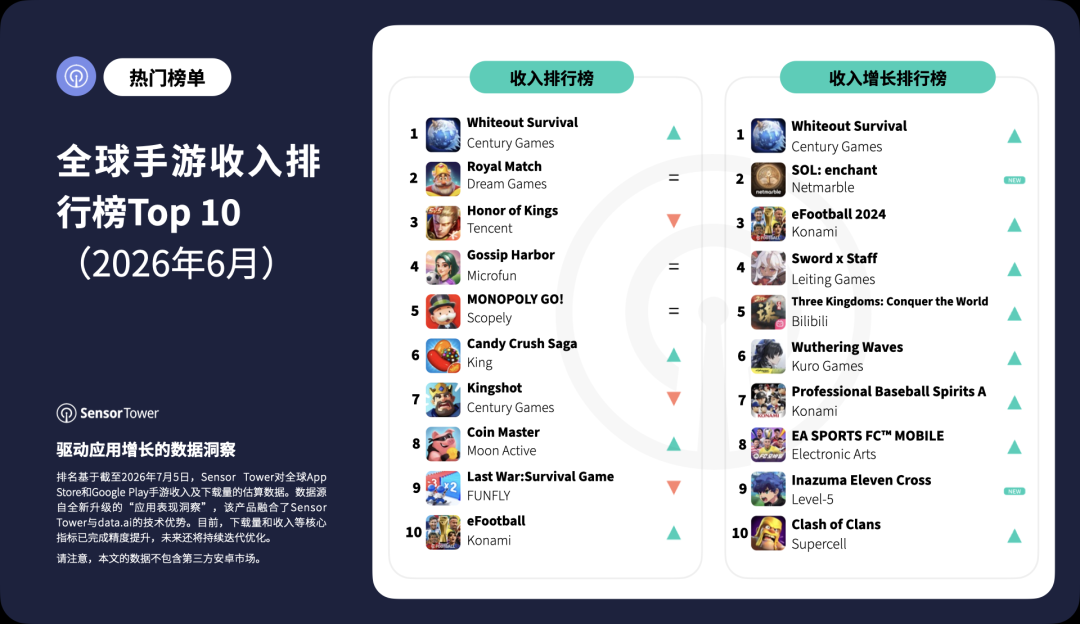
Among the ten leading publishers, three are Chinese enterprises, whose combined revenue takes up 49.9% of the Top 10 total revenue, nearly half of the overall top-tier market pool. By regional split, three U.S. companies make the list, with one publisher each from Europe, the Middle East and Southeast Asia. Chinese game firms outperform overseas counterparts in both revenue scale and market influence, reshaping the competitive landscape of the global mobile game industry.
II. Growth Drivers of the Three Top Chinese Publishers
1. Tencent Games ($5.03B, Global No.1, Flat Year-on-Year)
Tencent retains its unrivaled top position with revenue far exceeding the second-place publisher. Honor of Kings reclaimed the title of world’s highest-grossing mobile game, with H1 revenue rising 18% and downloads surging 32%. Its cumulative global IAP revenue has surpassed $17.5 billion as of end-June. *PUBG Mobile* delivers steady recurring revenue, while cross-platform shooter *Delta Force* maintains 50 million daily active users and has grossed over $900 million globally, forming a sustainable product portfolio covering MOBA, battle royale and shooter genres.
2. Century Games (FunPlus) ($1.93B, Global No.2, +4% YoY)
A benchmark Chinese overseas game developer, Century Games holds the second global spot for two consecutive years. Flagship SLG Whiteout Survival saw a 11% month-on-month revenue boost in June, topping the global mobile game chart that month with cumulative revenue approaching $5 billion. Another strategy hit *Kingshot* also grew 11% with total IAP exceeding $1.5 billion. New merge title Tasty Travels: Merge Game achieved explosive growth of 145% YoY revenue and 127% YoY downloads, creating dual growth engines of strategy and casual games.
3. Lemonplay ($1.06B, Global No.7, +30% YoY)
The biggest dark horse of this ranking, Lemonplay recorded the fastest year-on-year growth among all Top 10 publishers, jumping four positions to enter the global Top 7 for the first time. Its growth is fully driven by two female-oriented puzzle titles: Gossip Harbor revenue increased 34% YoY, while monthly revenue of Seaside Escape nears RMB 200 million. The company’s success proves Chinese mid-core casual games possess strong global monetization potential.
III. Performance of Overseas Top Publishers
Most of the seven non-Chinese top publishers reported year-on-year revenue declines. U.S. giant Scopely ranks third powered by its blockbuster MONOPOLY GO!; Microsoft’s subsidiary King maintains stable profitability via the iconic Candy Crush Saga franchise. Turkey’s Dream Games and Ireland’s Playrix rely on long-running match-3 hits to secure their rankings. Take-Two leverages its Zynga casual game portfolio to claim 8th place. Singapore’s FirstFun and Israel’s Moon Active faced revenue pressure due to reduced user acquisition spending and declining income from legacy titles.
IV. Industry Significance: Chinese Mobile Games Establish Unmatched Global Competitiveness
Absolute Advantage in Revenue Scale Three Chinese firms alone capture nearly half of the Top 10 global revenue share, ending the long-term monopoly of Western corporations over the high-end mobile gaming market. It demonstrates China’s mature system of game R&D, global publishing and long-term refined operation.
Diversified Genre Coverage Across All Major Tracks The three Chinese leaders cover core competitive multiplayer, global SLG and female-skewed casual puzzle respectively, forming a diversified overseas product matrix instead of relying on a single genre, greatly improving resilience against market cycles.
Mature & Sustainable Overseas Monetization Model Century Games and Lemonplay generate core revenue entirely from overseas markets, independent of domestic traffic. Their long-cycle operation and iterative content updates extend product lifespans, building a healthy growth model distinct from overseas developers’ short-term user acquisition strategies.
Dual Empowerment of Cultural Export & Industrial Economy Chinese mobile games dominate global markets while generating massive offshore revenue. As a major carrier of digital cultural export, they deliver Chinese narratives, aesthetics and values to global audiences, continuously elevating China’s discourse power in the global digital creative industry.
V. Industry Outlook
Competition in the global mobile game market intensifies, with long-term premium titles, diversified product pipelines and localized refined operation becoming core competitive edges. Chinese publishers represented by Tencent, Century Games and Lemonplay have secured positions in the global first tier. Moving forward, they will keep expanding into emerging markets and enriching product portfolios to further expand China’s market share and influence across the worldwide gaming sector.
Hot News
- Registration Opens for NVIDIA China Developer Day 2026 — A Premier Off line Tech Gathering for AI Developers in Suzhou
- Giving Back To The Industry: Nova Games Foundation Officially Launches To Empower Next Generation Game Creators
- Cozy Narrative-Driven Adventure Cat Secretary Launches on November 4th!
- Overwatch Rush Begins Soft-Launch in Southeast Asia, Blizzard Explores New Global Path for IP based Mobile Games
- GungHo to Shut Down Disney Pixel RPG on September 30, 2026
- Decorado: Alberto Vázquez on the Journey from Animated Short-film to Feature-length Animation
- CICF×AGF Guangzhou Anime-Game Festival: Greater Bay Area ACG Grand Event Lights Up National-Day Holiday
- Merge Mobile Game Sector Outlook 2026: Merge-2 Drives Robust Growth Amid Opportunities & Challenges