NVIDIA AI-Q Tops DeepResearch Bench Rankings
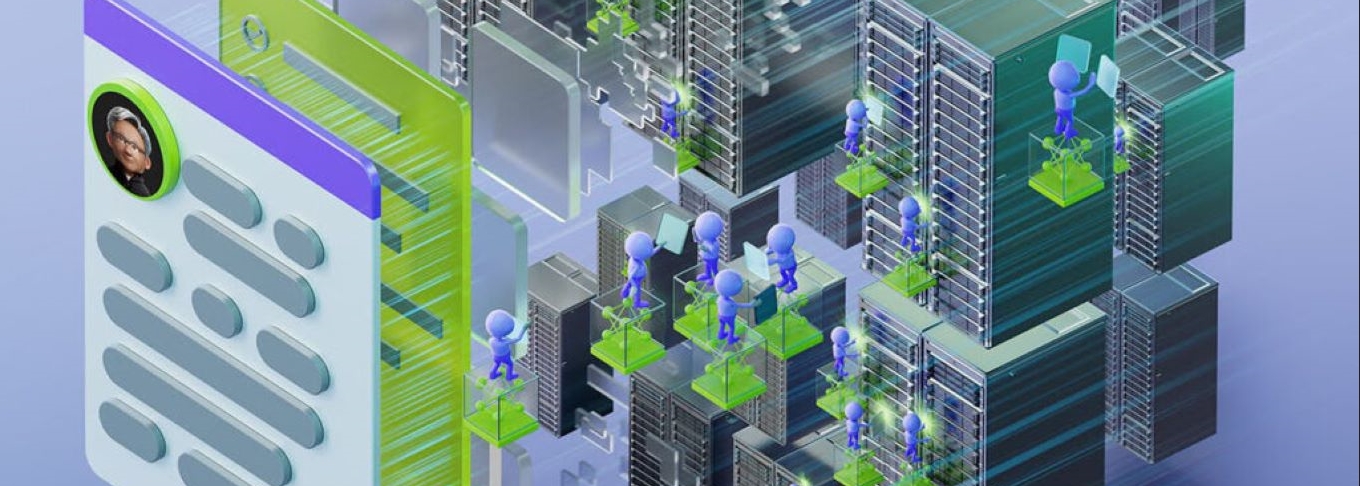
NVIDIA AI-Q Research Assistant Ranked #1 in Open-Source Deep Research Agent Benchmark
The NVIDIA AI-Q Research Assistant—an NVIDIA Blueprint for building AI agents with advanced reasoning capabilities—has claimed a top position on the DeepResearch Bench leaderboard, establishing itself as a leading open, portable, and high-fidelity research AI agent.
What is Agentic AI?
Agentic AI solves complex, multi-step problems through sophisticated reasoning and planning. These AI systems gather vast amounts of data from multiple sources to analyze challenges, formulate strategies, and autonomously execute tasks.
AI agents transform enterprise data into actionable knowledge for real-world execution.
Over time, they learn and improve by creating a data flywheel, leveraging human and AI feedback to refine models and enhance outcomes.
What is AI-Q?
The NVIDIA NeMo Agent Toolkit is a flexible, lightweight, and unified library that enables seamless integration of enterprise agents with data sources and tools across any framework.
Framework Agnostic: Works alongside existing agent frameworks like LangChain, LlamaIndex, CrewAI, and Microsoft Semantic Kernel, allowing teams to use their current tech stack without replatforming.
Extensible & Portable: Complements any agent framework without locking users into specific architectures, memory systems, or data sources.
Key features:
- Framework Agnostic:AIQ toolkit works side-by-side and around existing agentic frameworks, such as LangChain, LlamaIndex, CrewAI, and Microsoft Semantic Kernel, as well as customer enterprise frameworks and simple Python agents. This allows you to use your current technology stack without replatforming. AIQ toolkit complements any existing agentic framework or memory tool you’re using and isn’t tied to any specific agentic framework, long-term memory, or data source.
- Reusability:Every agent, tool, and agentic workflow in this library exists as a function call that works together in complex software applications. The composability between these agents, tools, and workflows allows you to build once and reuse in different scenarios.
- Rapid Development:Start with a pre-built agent, tool, or workflow, and customize it to your needs. This allows you and your development teams to move quickly if you’re already developing with agents.
- Profiling:Use the profiler to profile entire workflows down to the tool and agent level, track input/output tokens and timings, and identify bottlenecks.
- Observability:Monitor and debug your workflows with any OpenTelemetry-compatible observability tool, with examples using Phoenix and W&B Weave.
- Evaluation System:Validate and maintain accuracy of agentic workflows with built-in evaluation tools.
- User Interface:Use the AIQ toolkit UI chat interface to interact with your agents, visualize output, and debug workflows.
- Full MCP Support:Compatible with Model Context Protocol (MCP). You can use AIQ toolkit as an MCP client to connect to and use tools served by remote MCP servers. You can also use AIQ toolkit as an MCP server to publish tools via MCP.
Learn more at:
https://www.nvidia.cn/ai/?ncid=em-news-545978
熱門頭條新聞
- Yahoo Quietly Rebuilds Its Games Business: Daily Web-based Casual Games Open A New Growth Trajectory
- gamescom asia × Thailand Game Show 2026 Returns to Bangkok
- TIGA Submits Autumn Budget Proposals, Calls for Enhanced Video Games Expenditure Credit (VGEC) to Boost UK Games Industry
- Call for Entries Opens for FFAA 2027
- Rocketry, a Rocket Building and Space Exploration Simulator Coming to PC in 2027
- TOKYO GAME SHOW 2026 Marks Its 30th Anniversary with Record-Length Five-Day Run at Makuhari Messe; Complete Overview of Dates, Speakers, Exhibitors & On-Site Key Activities
- Hong Kong International AIGC Digital Creation Competition 2026
- Beyond Concept Verification: AIGC Film & Video Enters Commercial Realization Cycle in H2 2026