NetEase’s Justice AI Research Achievement Wins National-Level First Prize in Science and Technology, Gaming Intelligence Innovation Receives High Academic Recognition

Recently, the China Society of Image and Graphics officially announced the results of its 2025 Science and Technology Awards. The research project Key Technologies and Applications of Intelligent Decision-Making Based on Reinforcement Learning, jointly completed by NetEase (Hangzhou) Network Co., Ltd., Tianjin University, the University of Science and Technology of China, and the Seventeenth Research Institute of the Fourth Academy of China Aerospace Science and Industry Corporation, was awarded the highest-level “First Prize for Scientific and Technological Progress” by the Society. This achievement marks a breakthrough in the integration of cutting-edge artificial intelligence technologies and cross-disciplinary applications within the gaming industry. It also represents the first gaming-related scientific research outcome in China to receive authoritative recognition from a national-level academic institution in the field of intelligent decision-making.
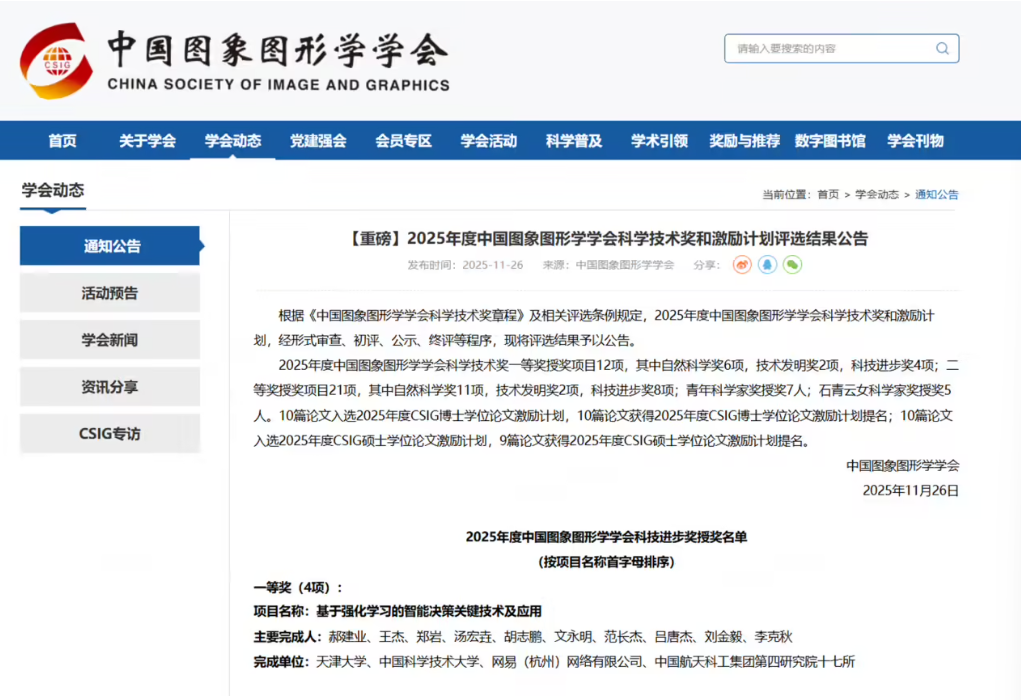
The China Society of Image and Graphics is the most authoritative and influential national academic organization in the field of image and graphics in China. Its awards focus on innovations in interdisciplinary fields that serve national strategic needs. The award-winning project centers on breakthroughs in the application of reinforcement learning technology in complex decision-making scenarios, with related achievements already implemented in critical fields such as aerospace navigation and defense equipment, demonstrating broad technical impact.
Notably, one of the significant application scenarios for this project is NetEase’s flagship martial arts open-world game, Justice. As early as two years ago, Justice pioneered the integration of its self-developed AI large model into gaming scenarios, launching the industry’s first “Intelligent NPC” system deeply embedded within game mechanics and capable of contextual interaction. Through a reinforcement learning framework, this system enables NPCs to dynamically adjust their responses based on player behavior, achieving highly realistic social interaction experiences.
Since then, Justice has continued to deepen the integration of AI technologies, introducing several innovative features:
- “AI Companion” System: Allows players to independently create digital entities with distinct appearances, voices, personalities, and life experiences through parametric settings, fostering long-term emotional connections. This feature previously sparked widespread resonance and ethical discussions on social platforms when players used it to “recreate” the images of deceased loved ones.
- AI Film Generation Tool “Studio Mode”: Built on the game’s core architecture, it enables real-time content generation driven by text input. Users only need to provide character descriptions, action commands, and dialogue to generate corresponding performances via AI and complete film production. The system also supports the import of external images or videos, which can be converted into in-game animations and expressions through AI motion capture, significantly expanding the boundaries of user creativity.
From the emotional interactions of intelligent NPCs to the open empowerment of AI creation tools, Justice has established a multi-layered AI ecosystem covering gaming experiences, content generation, and social connections. The project team stated that this series of innovations aims to transcend the boundaries of traditional gaming content and experiences through artificial intelligence technology, gradually constructing a next-generation open-world paradigm characterized by “infinite grandeur and infinite freedom.”
This award not only reflects the academic community’s high recognition of technological innovation in the gaming industry but also provides a national-level benchmark case for the interdisciplinary integration of “AI + Gaming.” Against the backdrop of artificial intelligence technology increasingly becoming a core area of national technological competition, the practices implemented in Justice may pave new technical pathways and expand the imaginative possibilities for the digital and intelligent transformation of the cultural and entertainment industries.
熱門頭條新聞
- Registration Opens for NVIDIA China Developer Day 2026 — A Premier Off line Tech Gathering for AI Developers in Suzhou
- Giving Back To The Industry: Nova Games Foundation Officially Launches To Empower Next Generation Game Creators
- Cozy Narrative-Driven Adventure Cat Secretary Launches on November 4th!
- Overwatch Rush Begins Soft-Launch in Southeast Asia, Blizzard Explores New Global Path for IP based Mobile Games
- GungHo to Shut Down Disney Pixel RPG on September 30, 2026
- Decorado: Alberto Vázquez on the Journey from Animated Short-film to Feature-length Animation
- CICF×AGF Guangzhou Anime-Game Festival: Greater Bay Area ACG Grand Event Lights Up National-Day Holiday
- Merge Mobile Game Sector Outlook 2026: Merge-2 Drives Robust Growth Amid Opportunities & Challenges