Germany’s Federal Game Development Funding Programme Allocates €267 Million Over Seven Years, Reshaping Domestic Gaming Industry Competitiveness
Launched in pilot mode back in 2019, Germany’s federal grant scheme for video-game developers has evolved into a permanent national industrial policy. According to calculations by GamesWirtschaft, a specialized gaming-industry media outlet, the programme has disbursed €266.98 million in non–repayable grants across seven years, supporting the development and release of 701 individual game projects. This games-specific funding sits within Germany’s broader federal investment architecture, complementing major instruments including the €500-billion Special Fund for Infrastructure and Climate Neutrality, the €30-billion Deutschlandfonds and the €10-billion Future Fund, all designed to strengthen digital industries, deep-tech capacity and small-and-medium-sized enterprises nationwide.
Programme Mechanics & Eligibility Rules
Administered by the Federal Ministry of Research, Technology and Space (BMFTR) and implemented by DLR-Projekträger, the project management agency of the German Aerospace Center, all disbursements are non-repayable grants with no pay-back obligation.
- Tiered grant intensity: Start-up studios (≤3-year-old) can receive grants covering up to 50 % of eligible production costs; SMEs qualify for up to 45 % cost coverage; large-scale corporations are capped at 25 % of production expenditure.
- Project financial thresholds: Minimum eligible project investment generally starts at €300,000, with a maximum grant cap of €8 million for any single project.
- Eligible project types: Brand-new digital games, major downloadable content, season passes, substantial platform ports and original game prototypes are all eligible for application.
- Mandatory qualification criteria: Applicants must maintain a registered office, permanent establishment or branch within Germany. Every submission needs to pass an official cultural-content test, and developers must secure private co-financing for the remaining share of project costs.
The annual budget for the games programme has risen to €125 million in 2026, scaling up public support for domestic video-game production.
Funding Distribution: Large Publishers Receive Nearly Half of Total Grants, While Independent Studios Also Benefit
Nearly half of all allocated funding has flowed to just 25 companies and their subsidiaries. The top-five grant recipients are listed below:
- Kalypso Media (lead project Tropico 7): €19.54 million;
- THQ Nordic (Project Super Shotgun): €13.51 million;
- Rockfish Games (Project Multispace): €10.17 million;
- King Art (Warhammer 40,000: Dawn of War IV): €9.46 million;
- Ubisoft (Anno 117: Pax Romana): €9.28 million.
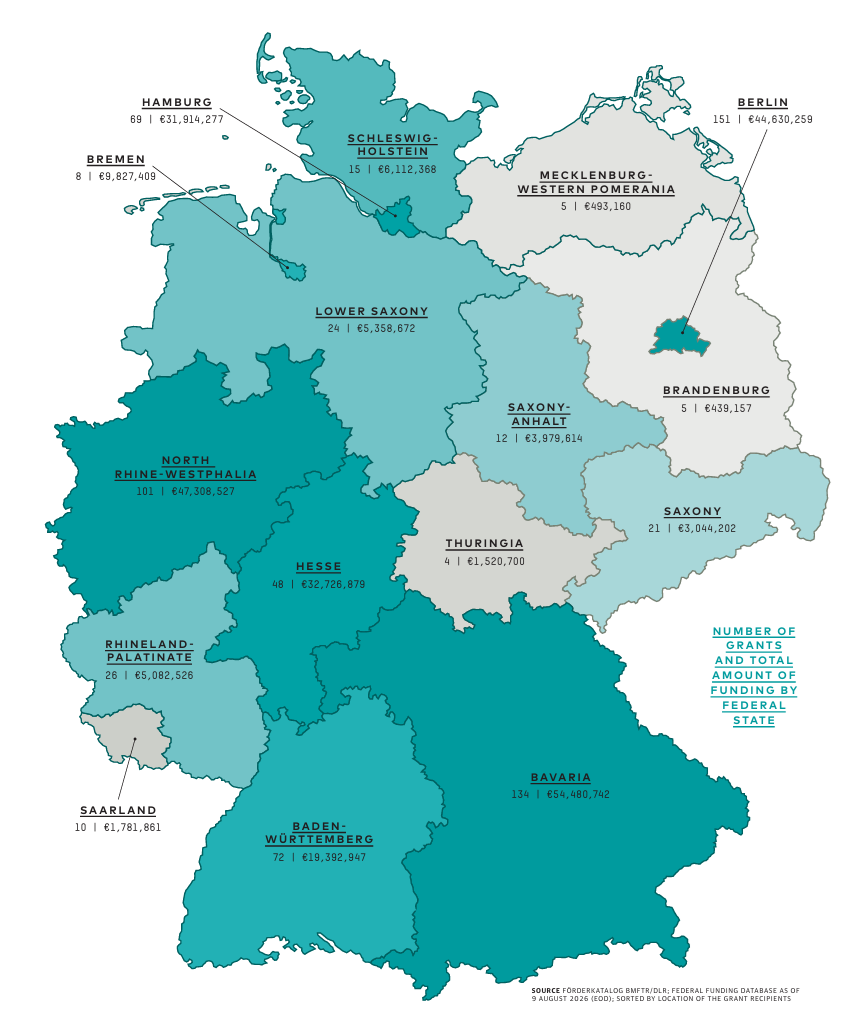
At the same time, numerous small and independent studios have secured programme support. Watershadow Games UG, a Baden-Württemberg-based casual-mobile developer, was awarded €173,759 for Hammony – Cozy Rhythm Adventure in the Black Forest. The studio specialises in casual mobile titles and creates digital experiences showcasing German local history, culture and natural landscapes, representing a typical cohort of subsidised independent teams. Geographically, Berlin, Bavaria and North Rhine-Westphalia lead both in grant count and total funding volume, concentrating Germany’s game-development resources within these key regions.
Broader Impacts on Germany’s Domestic Games Industry
This large-scale public-grant framework is transforming Germany’s gaming ecosystem across industrial structure, creative output, employment and global market positioning.
First, public funding lowers financial barriers and unlocks domestic creative capacity. Before the scheme was introduced, German small-sized studios commonly struggled with access to financing, facing persistent funding gaps for prototypes and mid-scale productions. Non-repayable grants can cover up to half of development expenses, materially mitigating downside financial risks. This enables more locally-rooted IP and culturally-infused game concepts to move from pitch to production. In total, 701 projects have obtained public backing over seven years, substantially expanding Germany’s domestic game output.
Second, tiered subsidy design supports both major publishers and independent creators, fostering a multi-tiered industrial ecosystem. Higher grant ratios for early-stage and SME studios help preserve independent-game diversity, alongside support for AAA-scale productions from established firms such as Kalypso Media, THQ Nordic and Ubisoft Germany. The portfolio of supported projects spans AAA titles, mid-sized productions, casual mobile games and experimental prototypes.
Third, the cultural-test requirement incentivises digital representation of German heritage. Applicants must satisfy cultural-content criteria, encouraging developers to integrate German history, regional folklore and local landscapes into interactive works. Video games are increasingly treated as a digital-cultural medium alongside their commercial function.
Fourth, sustained public investment strengthens domestic talent pools and raises Germany’s international profile within the global games market. Expanded project pipelines generate local development jobs, helping retain skilled programmers, artists and designers and limiting brain-drain overseas. The federal government frames the programme as a core instrument to turn Germany into one of Europe’s leading video-game-production hubs.
Industry observers also point out structural challenges: nearly half of total grant money is concentrated among 25 corporate recipients. In addition, grants only constitute partial co-financing; studios still need to secure remaining project capital on the private market, creating hurdles for micro-teams with no existing commercial track-record. Future policy refinement will likely focus on improving distribution fairness and expanding access for very small independent developers as annual funding continues to expand.
熱門頭條新聞
- New AI, New Computing — The 7th AI Computing Conference (AICC2026) Grandly Opens in Beijing
- Germany’s Federal Game Development Funding Programme Allocates €267 Million Over Seven Years, Reshaping Domestic Gaming Industry Competitiveness
- PIF-Backed Merger Proposal Between EA and Savvy Games Could Reshape Global Gaming, With Far-Reaching Impacts on Both Parties’ Businesses
- Farming Camp Demo Expands to PS5, Xbox, Switch & Microsoft Store
- MIPJUNIOR 2026 to Open in Cannes: Full Introduction of Dates, Participation Channels, Core Sessions and Industry Significance
- Chill with You: SHIOI’s Sparkling Scenes – Steam Store Page Is Now Live
- SIGGRAPH Asia 2026 Takes Shape: Distinguished Keynote Speaker Line-up Unveiled
- Apple Completes App Store Leadership Transition; New Management Pursues Higher Margins, Phil Schiller Steps Back From Day-to-Day Operations