Digital Technology Revitalizes Intangible Cultural Heritage — Jingdezhen World Heritage Inscription Sets Global Model for Chinese Traditional Culture Global Communication
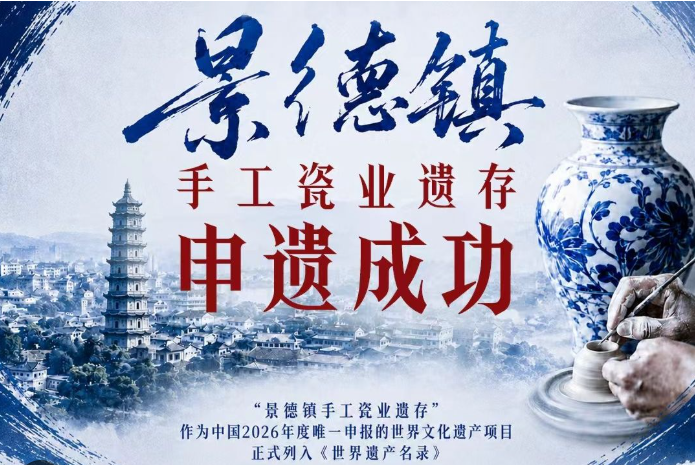
On July 25 local time, the 48th Session of the UNESCO World Heritage Committee held in Busan, South Korea, approved the inscription of Jingdezhen Handicraft Porcelain Industry Sites on the World Heritage List. China now boasts 61 World Heritage Sites, filling the long-standing blank of porcelain-themed heritage within the global UNESCO framework. The millennia-old porcelain capital earned global recognition thanks to its complete industrial heritage spanning the entire handmade porcelain production chain. More importantly, leveraging cutting-edge technologies including AI, digital twin, interactive gaming and big data monitoring, Jingdezhen has pioneered a modern development model for intangible cultural heritage (ICH) featuring tech-driven conservation, digital activation, public participation and global communication, offering a replicable Chinese blueprint for the inheritance and international outreach of traditional Chinese culture and crafts. Lin Jian, Spokesperson of China’s Ministry of Foreign Affairs, stated the inscription embodies the Global Civilization Initiative and promotes exchanges and mutual learning among civilizations. He stressed that the successful World Heritage listing marks a new starting point rather than an endpoint for the innovative development of cultural heritage in the digital age.
1. Multi-dimensional Digital Technology Consolidates Heritage Conservation, Addressing Global Challenges of Handicraft Heritage
Jingdezhen Handicraft Porcelain Industry Sites cover 5 core zones, 15 heritage components and 45 heritage spots with a total area of over 7,500 hectares. The site has long faced universal conservation challenges for large-scale handicraft heritage, including kiln water seepage, relic weathering, unstable layered kiln deposits and corrosion of ancient wooden architecture. Jiangxi Province and Jingdezhen City prioritized digital technology to build a full-chain intelligent conservation system, forming the “Jingdezhen Model” for systematic protection of massive industrial heritage:
- Integrated Space-Ground-Air Intelligent Monitoring Network A total of 789 professional monitoring devices have been deployed across the heritage area to build a three-dimensional perception system combining ground sensors, drone patrols and manual inspections. The system delivers real-time alerts and closed-loop disposal for relic settlement, underground water level fluctuations, wildfire risks and historical landscape damage. For remote mining sites such as Kaolin Clay Mine and Changling Stone Mine, lightweight AR mini-programs provide automatic site commentary and allow visitors and residents to report relic damage instantly, establishing a public digital heritage supervision mechanism.
- World’s First Ancient Porcelain Gene Bank to Permanently Preserve Porcelain Civilization Data Built upon nearly 20 million pieces of unearthed ancient porcelain shards, the exclusive Ancient Porcelain Gene Bank employs Raman spectroscopy and electron microscopy to conduct micro-component analysis of porcelain fragments, accumulating over 1.5 million sets of craft data. This digital archive serves as a scientific reference for archaeological restoration and porcelain authentication, while stockpiling massive patterns and vessel shapes for contemporary cultural and creative production, transforming broken pottery shards into permanent digital cultural assets.
- Digital Twin Technology Restores the Complete Ancient Porcelain Capital Supported by AI+PCG procedural generation and high-precision 3D modeling, the technology reconstructs the full production and living landscape of ancient Jingdezhen from the Song to Ming dynasties, covering workshops, kilns and river shipping docks on the original archaeological ground with only brick and soil foundations left. It fully reproduces the whole industrial chain from clay mining, porcelain shaping, painting to overseas river transportation, eliminating the limitations of fragmented physical relics and enabling the public to trace the thousand-year evolution of porcelain craftsmanship intuitively.
2. Innovative Digital Interactive Communication Channels Bridge Young Audiences and Traditional Culture
Breaking away from static museum displays, Jingdezhen has developed multi-level digital interactive products that adopt youthful formats such as video games and IP cross-border cooperation to narrow the distance between the public and traditional culture, realizing lightweight and engaging popularization of ICH craftsmanship:
- World’s First UNESCO Heritage-Themed AI Mini-Game Digital Jingdezhen: Porcelain CraftsmanLaunched Simultaneously Released on the day of the World Heritage approval, the game invites players to role-play ancient kiln workers and experience all 72 traditional porcelain-making procedures. An AI digital mentor embedded in the game answers real-time questions about core crafts including blue and white porcelain, dual clay formula and famille rose enamel, drawing on a multi-modal porcelain culture database. AI 3D generation technology lowers creation barriers: users can convert simple sketches into customized porcelain wares, allowing audiences without professional training to immerse themselves in ICH craftsmanship, attracting massive young users upon launch.
- Cross-Border Game IP Collaboration Boosts Global Outreach of Porcelain Culture Tencent’s tactical shooter Delta Forcepartnered with Jingdezhen Imperial Kiln Museum for a digital cultural creation project. Three national treasure porcelain artifacts — Chenghua Doucai Chicken Cup, Yongle Underglaze Red Dragon Vase and Chenghua Sancai Duck Incense Burner — were precisely modeled at a 1:1 scale and integrated into the globally distributed game. Covering app markets across 169 countries and regions, the game disseminates Chinese porcelain culture to young overseas players via trendy interactive content, opening a brand-new digital channel for global cultural export.
- Integrated Online-Offline Digital Experience Ecosystem Interactive large screens and naked-eye 3D relic restoration installations are installed at Taoyangli Historical Block and Imperial Kiln Museum. Online digital exhibition halls and artifact identification systems receive over 7.6 million virtual visits annually. Live streaming of ancient kiln firing and opening ceremonies, alongside short-video e-commerce, creates a full industrial chain of “viewing-experiencing-consuming”, driving revenue growth for porcelain cultural and creative industries and realizing integrated heritage conservation, cultural communication and public benefit delivery.
3. Demonstration Value of Jingdezhen’s Digital Practice: Standardized Reference for National ICH Inheritance
Jingdezhen’s model of heritage protection via full industrial chain resources and digital technology provides clear replicable solutions for all forms of Chinese ICH including opera, embroidery, wood carving and ancient architecture, summarized into four scalable development paths:
- Digital Archiving for Permanent Preservation of ICH Craftsmanship Against the risks of aging inheritors and lost craftsmanship, high-precision scanning, audio-video recording and AI data extraction fully document traditional procedures, patterns and oral histories to build standardized ICH databases and prevent the disappearance of intangible heritage. Similar practices have been adopted nationwide: Sichuan Qiang embroidery leverages AIGC to generate modern patterns and solve design bottlenecks for artisans; Dunhuang murals and Anyue stone carvings use 3D modeling to permanently preserve grotto details, drawing lessons from Jingdezhen’s digital archiving framework央广网.
- Diversified Digital Channels to Cover Audiences of All Age Groups Interactive mini-games and digital research courses target teenagers; AR navigation and cloud exhibitions cater to the general public; global outreach via video games, films and digital IP crosses barriers of geography, language and age, transforming traditional culture from niche content to mainstream public culture.
- Integration of Technology and Industry to Stimulate Self-sustaining ICH Development Digital cultural assets fuel cultural creation, online e-commerce and cultural tourism experiences, forming a sustainable closed loop where digital content drives tourism consumption and tourism revenue funds heritage protection. This fulfills the core philosophy of “heritage for the people, benefit the people”.
- Open Digital Resources to Facilitate Cross-Civilization Exchange In line with the Global Civilization Initiative, Jingdezhen opens its porcelain gene bank and 3D relic models to global scholars and creators free of charge, building a digital bridge for dialogue between Chinese and foreign civilizations and embodying the vision of “harmony amid diversity”.
4. Future Outlook: Promote Fine Traditional Chinese Culture Globally Through Digital Technology
Senior officials from the Ministry of Culture and Tourism and National Cultural Heritage Administration stated that China will systematically promote Jingdezhen’s digital conservation and activation experience nationwide and fully implement the national strategy for cultural heritage digitization: First, improve national infrastructure for ICH big data, unify standards for collection, storage and open access of cultural digital resources, and build a national cultural data trading platform to standardize the circulation of digital assets of cultural relics and intangible heritage. Second, deepen integrated innovation of “AI + Culture”, support R&D of new cultural products including video games, metaverse and VR immersive exhibitions, and continuously lower the threshold for public engagement with traditional culture. Third, leverage the international “AI +” Cooperation Initiative to jointly build digital heritage laboratories with UNESCO and cultural institutions worldwide, share China’s ICH digital conservation solutions and contribute Chinese wisdom to global cultural inheritance. Fourth, advance deep integration of digital technology with cultural tourism, education and creative industries, foster new digital ICH business formats, and enable Chinese porcelain, silk, painting, opera and other traditional cultures to reach global audiences via digital carriers, polishing the iconic cultural business card of Chinese civilization.
The Ministry of Foreign Affairs emphasized that China will continue to take digital technology as a bond to fully implement the Global Civilization Initiative, actively participate in global governance of World Heritage, and facilitate equal dialogue, exchange and mutual learning among diverse civilizations through digital cultural communication, injecting profound humanistic strength into building a community with a shared future for mankind.
Hot News
- SIGGRAPH Asia 2026 Takes Shape: Distinguished Keynote Speaker Line-up Unveiled
- Apple Completes App Store Leadership Transition; New Management Pursues Higher Margins, Phil Schiller Steps Back From Day-to-Day Operations
- Apple’s new EU App Store Business Terms Still Violate the Digital Markets Act (DMA).
- Lost and Found Co. Developer Bit Egg Becomes First Game Studio to Win Thailand’s Prestigious Prime Minister’s Export Award
- DRAGONHEIR: SILENT GODS MARKS THIRD ANNIVERSARY WITH COMMUNITY-CREATED HERO AND ORDER VS. CHAOS SHOWDOWN
- China Domestic Animation Summer Season 2026 Review: Box-office Boom for Theatrical Animation, Established Web Series Face Headwinds, AI Man-Dramas Explode for New Growth
- Tianji: Shadow of the Ancients, Coming 2027 to Multiple Global Platforms
- China’s Anime-Goods (“Guzi”) Economy 2026 Market Review