Google Play’s Biggest Fee Overhaul in a Decade Takes Effect: What the Split of Service and Billing Fees Means for the Industry
Google Play has rolled out its most disruptive business model change since the store’s inception.
From today, developers in the United States, the United Kingdom, and the European Economic Area will see Google’s traditional 30% commission split into two separate components: a service fee and a billing fee — while third-party payment options become available for the first time on a global scale. The changes stem from Google’s settlement with Epic Games after years of antitrust litigation, but their implications reach far beyond a single legal dispute — they are reshaping the fundamental economics of the mobile app ecosystem.
What’s Changing: Lower Fees, but with Strings Attached
The new fee structure is built on a “service-payment decoupling” logic:
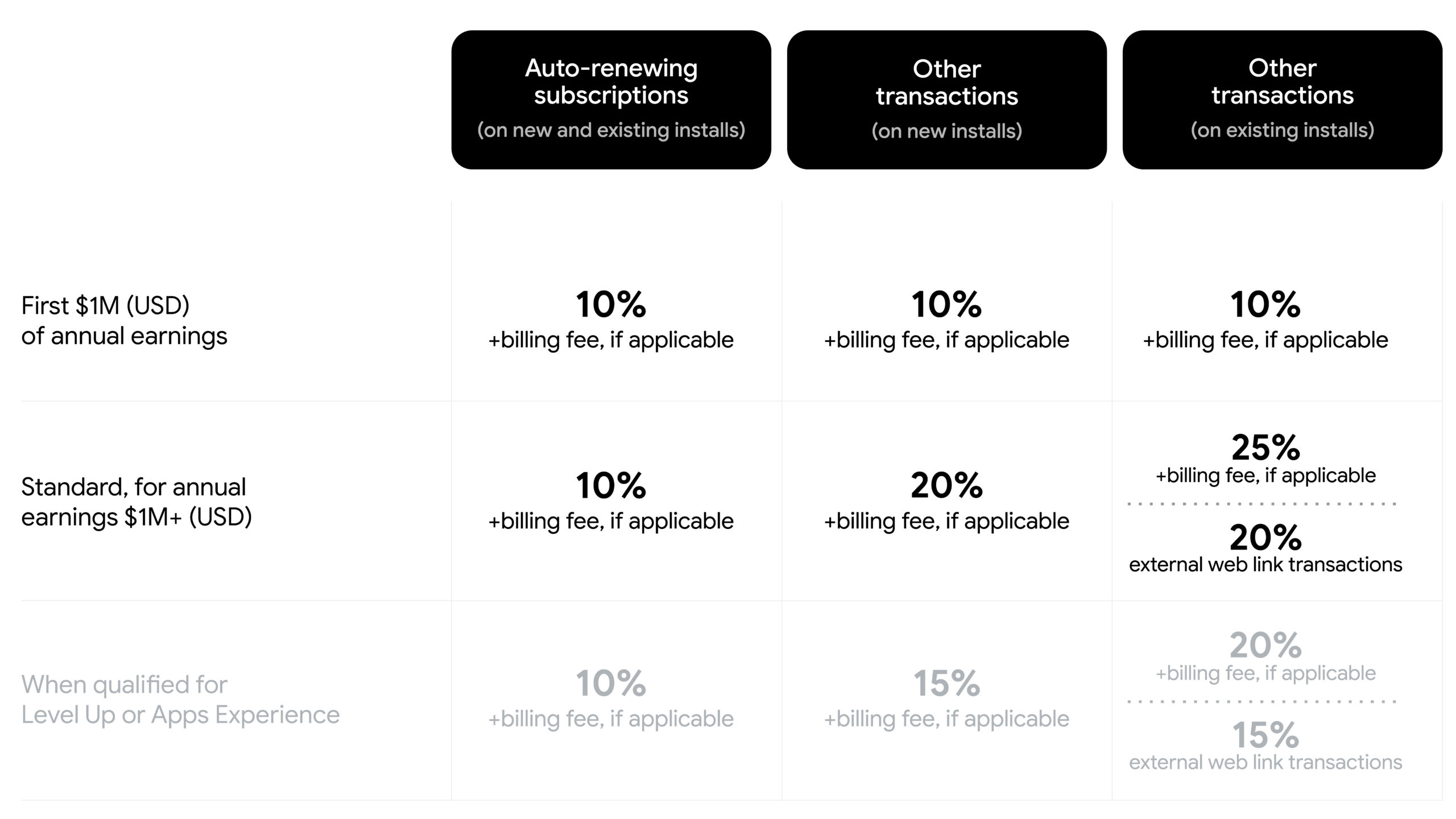
Service Fee: A flat 10% on the first $1 million in annual earnings (including auto-renewing subscriptions). Above that threshold, the rate depends on install timing — 20% for transactions from new installs, and 25% for existing installs.
Billing Fee: An additional 5% applies only when developers use Google Play’s own billing system. Those who adopt alternative payment methods or direct users to external websites for purchases pay no billing fee.
Google has also revamped its Games Level Up program and introduced a new Apps Experience program. Developers who meet specific technical criteria — integrating Play Games Services v2 SDK, Google’s AI-powered Sidekick, cloud save, achievements, and big-screen compatibility — can qualify for a reduced 15% service rate on earnings above $1 million.
The rollout will proceed in phases: Australia from September 30, 2026; Japan and South Korea from December 31, 2026; and the rest of the world by September 30, 2027.
Google’s Strategic Calculus: Concession or Controlled Evolution?
On the surface, this looks like a forced retreat — the judge in the Epic v. Google case had once considered radical remedies, including forcing Google to distribute third-party app stores within Google Play. The settlement avoided that worst-case scenario, allowing Google to make changes on its own terms.
But a closer look reveals a strategic move disguised as a concession.
First, “selective discounts” reinforce ecosystem control. The supposedly open third-party billing comes with detailed UX guidelines — developers may design their own payment choice screens, but must comply with Google’s UX requirements. Google retains the power to define the user experience. Meanwhile, the Level Up program’s additional 5% discount requires deep integration with Google’s technology stack — from Play Games Services to Sidekick, from cloud save to PC compatibility — creating high switching costs for participants.
Second, the “service fee” framework preserves core economics. Splitting 30% into “25% service + 5% billing” may appear more transparent, but for most mid-to-large developers, the total rate reduction is modest. The real beneficiaries are long-tail developers earning under $1 million annually — they pay just 10% regardless of payment method.
Third, the phased rollout buys time. Staggering implementation across regions over more than a year gives developers room to adapt while allowing Google to fine-tune its approach based on regulatory feedback.
Industry Impact: Winners, Losers, and New Dynamics
▶ Independent and Small Developers: A Genuine Win
For developers earning under $1 million annually, the service fee drops from 30% to 10% — a two-thirds reduction. This means more retained profits and greater room for experimentation. In an era of rising user acquisition costs, this could be a catalyst for long-tail innovation.
▶ Major Publishers: Modest Savings, Deeper Lock-in
For top-tier developers far exceeding the $1 million threshold, the effective rate moves from 30% to 25% (new installs) or remains near parity (existing installs at 25%). Level Up certification can shave another 5 percentage points — but at the cost of full integration with Google’s ecosystem. It’s a trade-off: lower fees in exchange for deeper platform dependency.
▶ Third-Party Payment Providers: A Structural Opportunity
The 5% billing fee waiver gives third-party processors like Stripe and Adyen their first direct cost advantage over Google Play Billing. For developers targeting emerging markets, local payment options may also boost conversion rates. The next 12 months could see a surge in third-party payment integration services.
▶ The Gaming Sector: Level Up May Reshape Quality Standards
The Level Up program’s technical requirements — Play Games Services v2, Sidekick, achievements, cloud save, PC compatibility — effectively establish an official benchmark for “high-quality Android games.” This could create a ripple effect: those who meet the standard enjoy fee discounts, while those who don’t may face a competitive cost disadvantage, potentially raising the industry’s overall technical baseline.
▶ Global Regulation: A Reference Point for Antitrust Frameworks
Google’s proactive adjustment is largely a response to the EU’s Digital Markets Act and U.S. antitrust pressure. The early rollout in the EU, U.K., and U.S. may offer a reference for other jurisdictions — demonstrating that platform holders can make meaningful concessions without fully opening their ecosystems, and providing a real-world test case for the “service-fee-plus-billing-fee” model.
Conclusion: The End of the 30% Era — But Not the End of Platform Power
Google Play’s fee overhaul marks the formal end of the “one-size-fits-all 30% commission” era in mobile app stores. But whether this truly liberates developers is far from certain.
On one hand, lower fees and open payment options genuinely reduce costs and lower the barrier to innovation. On the other, through Level Up’s technical lock-in and UX guideline control, Google is finding more sophisticated ways to maintain its grip on the ecosystem. The form of monopoly may be changing, but the underlying logic of platform economics — defining ecosystems through rules and locking in developers through technology — remains intact.
For developers, the new rules doesn’t offer liberation — it presents a new choice: embrace Google’s technology stack for fee discounts, or stay independent at a higher cost. That choice, in itself, may be the most profound impact of this reform.
Editor:Sophia
熱門頭條新聞
- Reborn · Stone Age Kicks off Second Reunion Closed Beta Test, Reviving a Pioneering Chinese Online Game Classic
- Chill Survival Adventure Until North Ends Launches in Early Access on August 31st
- Pixel Washer Cranks Up the Pressure With New Trailer Full of Grimy Locales, Slick Sprayers, and Sweet Rides
- Wuxia Animation Cup of Snow Scheduled for Release on August 25, 2026
- Aiming To Rival Hello Kitty: Sony Invests Heavily In Original Mascot IP Project
- 2026 Taichung International Anime & Manga Expo Unveiled, “Manga & Food Memories” Blends Local Cuisine with ACG Culture, Original Comic Contests Launched
- Talking Tom & Friends: World Launches Global The Smurfs Crossover Update, Two Generational Kids IPs Unite for Creative Sandbox Fun
- Vancouver Rises as Global Mobile Gaming Powerhouse, Backed by Integrated Industrial Advantages