The PC Gaming Industry at a Crossroads: Opportunities, Dilemmas and Future Trends – A Comparative Analysis with the Domestic Market

According to the latest “2026 PC and Console Gaming Report” released by Newzoo, the global PC gaming industry is undergoing a structural transformation. Although user engagement in free-to-play (F2P) models has declined across all platforms, the PC platform stands out with superior monetization efficiency, a strength particularly evident in Western markets. Meanwhile, driven by policy support and local innovation, China’s domestic PC gaming market has embarked on a uniquely distinctive development path. This article sorts out the opportunities, dilemmas and future trends of the global PC gaming industry, and conducts an in-depth comparison with the domestic market to provide reference for industry participants.
Global PC Gaming: Prominent Opportunities Amid Adjustment
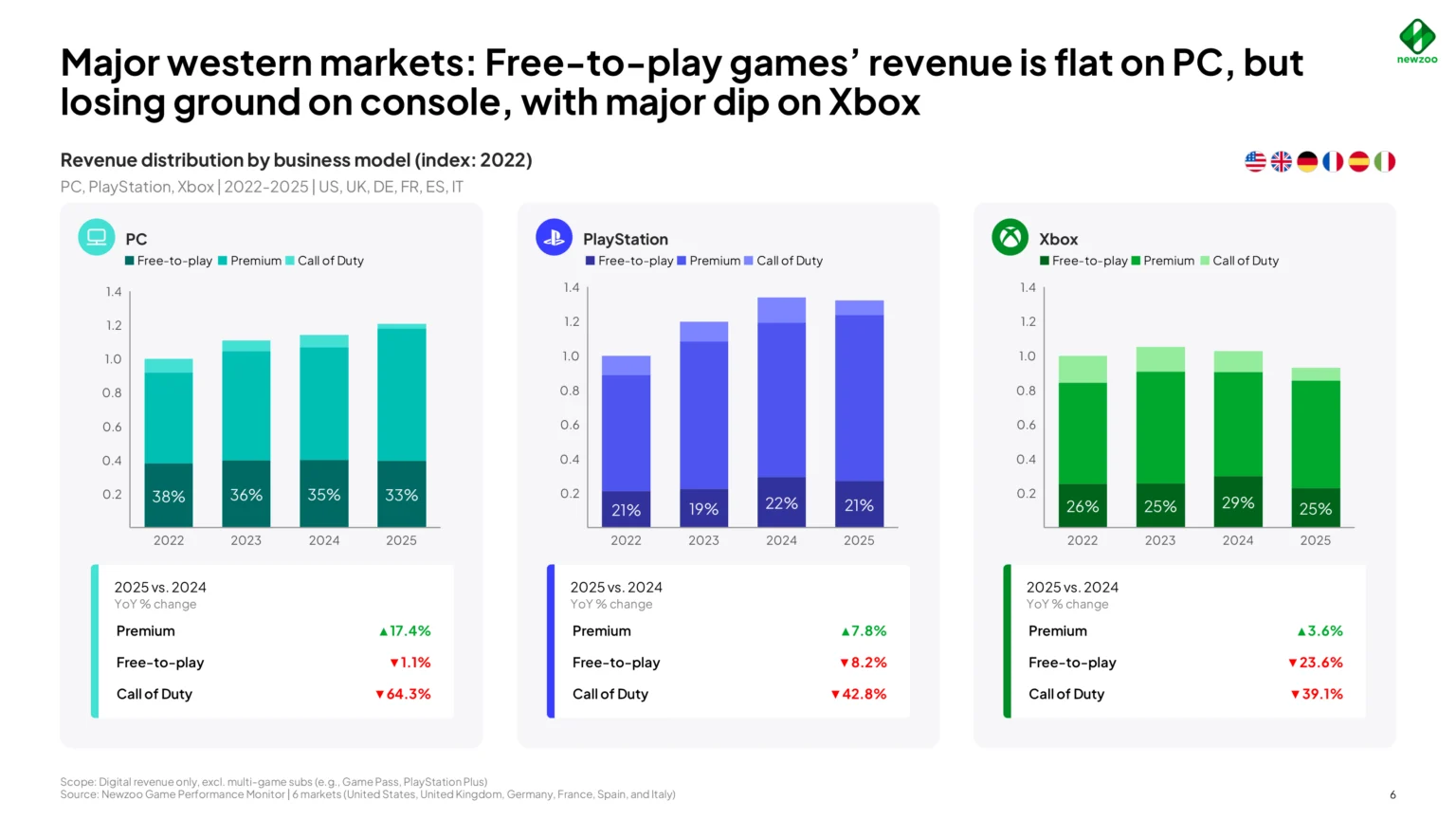
Despite the overall adjustment of the global gaming market, the PC gaming industry in major Western markets represented by the United States, the United Kingdom, Germany, France, Spain and Italy still contains significant opportunities. The most prominent advantage lies in its excellent monetization efficiency of the free-to-play model: data shows that in 2025, the F2P revenue per hour on the PC platform was nearly twice that of the PlayStation platform and three times that of the Xbox platform, with a year-on-year growth of 10%, demonstrating strong resilience.
This advantage is supported by multiple structural factors: a mature long-term operation ecosystem, a player base accustomed to long-term monetization cycles, and strong willingness of players to pay in cosmetics-driven ecosystems. For example, although the total playtime of “Fortnite” on the PC platform has decreased, its revenue still reached 1.7 times the average level of the platform, which proves that high user loyalty can maintain strong monetization capabilities even when engagement declines.
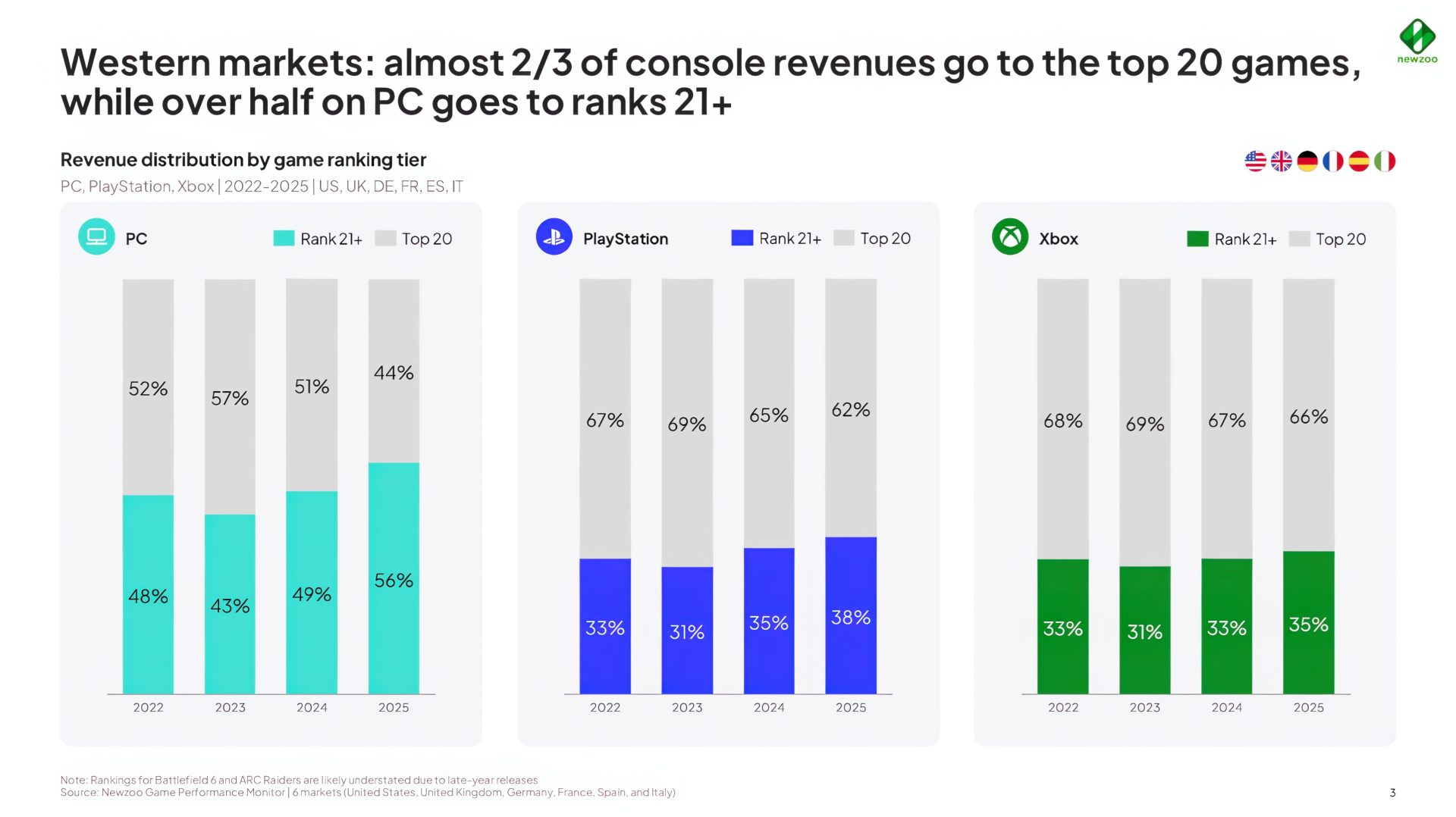
Another key opportunity is the expansion of the “long-tail market”. In 2025, games ranked outside the top 20 accounted for 56% of the total PC gaming revenue in Western markets, a significant increase from 48% in 2022. This reversal indicates that the market is no longer dominated solely by top AAA games, and mid-sized games and independent games are gaining more revenue and playtime. From 2022 to 2025, the playtime of games ranked 21st and above increased by 44%, while the total PC gaming playtime increased by 14%, showing that the long-tail market is expanding synchronously with the entire platform, rather than at the expense of the head market.
In addition, the diversification of game genres and business models has also provided new growth drivers. Among games ranked outside the top 20, role-playing (RPG) and adventure games perform prominently on all platforms, among which paid games account for 73% of the playtime in the long-tail market of the PC platform. Classic catalog games such as “Cyberpunk 2077” and “The Elder Scrolls V: Skyrim” still maintain high popularity with the support of active mod communities, further enriching the PC gaming ecosystem.
Global PC Gaming: Unavoidable Industry Dilemmas
Despite the bright spots, the global PC gaming industry still faces many severe challenges. The most prominent problem is the overall decline in playtime of the free-to-play model: in 2025, the F2P playtime on the PC platform decreased by 8.1% year-on-year, but it still accounted for 44% of the total playtime. This decline is partly due to the rise of paid games, such as “Battlefield 6” and “Arc Raiders”, which have diverted players’ attention from free-to-play experiences.
The imbalance in individual game performance is another core dilemma. Although the PC platform has strong overall monetization efficiency, many large free-to-play ecosystems have shown signs of fatigue, and not all PC free-to-play games can achieve sound development. At the same time, the dominant position of head games is deeply entrenched: since 2023, the top 5 list of PC game revenue has remained unchanged, and only a few new games such as “Marvel Rivals” and “Wuthering Waves” successfully entered the top 20 in 2025, indicating that the threshold for new games to enter is extremely high.
In addition, the market’s shift from “pursuing scale” to “pursuing monetization efficiency” has also raised the entry threshold for developers. As user engagement no longer expands continuously as it did during the pandemic, converting players’ attention into stable revenue has become more critical, and many studios struggle to adapt to this shift in core focus and fall into development difficulties.
Future Development Trends of Global PC Gaming
Looking ahead, the global PC gaming industry will focus on three core trends. First, monetization efficiency will become a core competitive factor. As playtime stabilizes, platforms and developers will shift their focus from “pursuing scale” to “optimizing monetization models”, and the free-to-play model will gradually form platform-specific business models rather than a unified operation idea.
Second, the importance of the long-tail market will continue to increase. The expanding proportion of revenue and playtime from non-head games will attract more capital to invest in mid-sized and independent game fields, promoting the ecosystem to develop in a diversified direction. Developers will pay more attention to niche genres and long-term post-launch operations to tap the growth potential of the long-tail market.
Third, the integration of paid models and free-to-play models will be further deepened. Although the top 20 PC games are still dominated by free-to-play ecosystems, the long-tail market is led by paid games, which means that balancing the two models will become a core strategy for developers to adapt to market changes.
Domestic PC Gaming Market: A Uniquely Distinctive Development Path
Compared with the Western PC gaming market, China’s domestic PC gaming industry presents unique development characteristics, with both opportunities and challenges. In terms of opportunities, policy support has become a core driving force: the relaxation of game approval policies has accelerated the launch rhythm of new games, and the support for independent game development has also created a more dynamic creative environment. According to the latest market data, the scale of China’s domestic PC gaming market reached 89.2 billion yuan in 2025, with a year-on-year growth of 4.1%. Although the growth rate is lower than that of the Western market, its proportion in the overall gaming market has increased to 27.3%, highlighting the importance of the PC platform.
Local independent games have become a bright spot in the industry, and works such as “Black Myth: Wukong” have gained global recognition, demonstrating the improvement of China’s PC game development capabilities. At the same time, China’s domestic PC gaming market is transforming from “quantity growth” to “quality improvement”, and players’ willingness to pay for high-quality content continues to increase — in 2025, the per capita payment of domestic PC game users reached 286 yuan, a year-on-year growth of 7.8%, echoing the trend of focusing on monetization efficiency in the Western market. In addition, the revenue of domestic PC independent games reached 11.2 billion yuan in 2025, a year-on-year growth of 18.3%, far exceeding the overall PC gaming market, becoming a new growth engine.
However, China’s domestic PC gaming market also faces unique dilemmas. The market concentration is extremely high, and local giants such as Tencent and NetEase dominate the head game list, making it difficult for small and medium-sized independent studios to compete with them — in 2025, the revenue of the top 10 domestic PC games accounted for 68.5% of the overall market, while this proportion in the Western market was only 44%. In addition, the popularity of mobile games has diverted part of players’ attention, and the playtime of domestic PC game users only increased by 1.2% year-on-year in 2025, far lower than the total growth rate of 14% in the Western market.
There are also obvious differences in business models: Western PC games rely heavily on the “free-to-play + cosmetics monetization” model, with the long-tail market dominated by paid games; while China’s domestic PC gaming market is dominated by subscription and buy-to-play models, with free-to-play games accounting for less than 30%. At the same time, the development of domestic mod communities is not mature enough, which limits the long-term vitality of catalog games — in 2025, the proportion of playtime of domestic catalog PC games was only 35%, far lower than 58% in the Western market.
Comparison and Outlook: Integrated Development, Diversified Coexistence
The global and domestic PC gaming markets share many common trends, such as the transformation to “quality improvement and efficiency enhancement” and the increasing importance of the long-tail market, but there are still significant differences in market structure, business models and player preferences.
In the future, the Western PC gaming market will continue to give play to the advantages of monetization efficiency and the long-tail market, while the domestic market will focus on independent game innovation and integration with the global ecosystem. With the deepening of globalization, the exchanges and cooperation between the two markets will continue to strengthen, jointly promoting the overall development of the global PC gaming industry.
Mehmet Sahin, Junior Market Analyst at Newzoo, said: “The PC gaming industry is entering a mature stage, where differentiation and efficiency have become core keywords. Both the global and Chinese markets face challenges, but the opportunity lies in adapting to changes in player needs and building a more diversified and resilient industry ecosystem.”
熱門頭條新聞
- Wuthering Waves Version 3.6 Lamplight in Mirage, Swords Resolve in Heart Out Now
- Rovio Revenue Stabilises Following USD 200M Impairment and Internal Restructuring;
- Annual Report of the German Games Industry 2026 published
- Woodland fantasy RPG Songs of Glimmerwick comes to Steam on September 30th!
- gamescom dev awards 2026 recognize outstanding indie games and industry contribution
- BOMBANANA! Set to Launch on 2 September 2026 on PC via Steam!
- Netflix Shuts Down Night School Studio and Moonloot Games, Restructures Gaming Division and Reshapes Its Entertainment Business Mix
- DCU Wonder Woman Reboot Gets First Official Update From Screenwriter