Ugo Bienvenu: “France Has the Capacity to Produce a Major Animated Adventure Film”
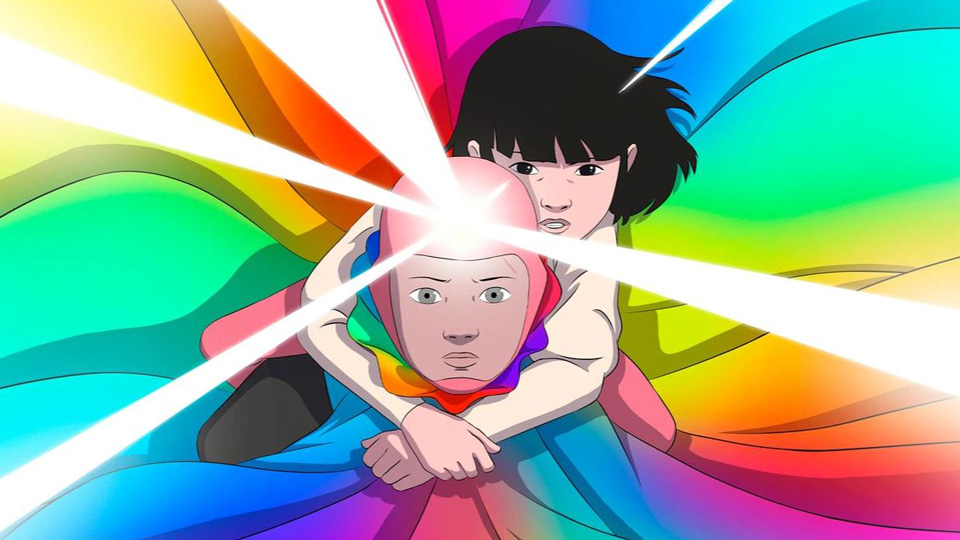
Awarded the Best Feature Crystal at the latest Annecy Festival, Arco follows a boy who travels through time from 2932 to 2075, where he is taken in by a young girl determined to help him return home. Its director, Ugo Bienvenu, walks us through the making of this film co-produced by MountainA, Natalie Portman and Sophie Mas’s company.
You are the author of about ten graphic novels, the short film The Interview – co-directed with Félix de Givry – for the Opéra Garnier’s Third Stage, and 6 episodes of Marvel’s Ant-Man animated miniseries. Had the idea for a feature film been on your mind for long?
Ugo Bienvenu: I had wanted to do one several years ago but gave up on the idea. I even wrote the graphic novel Payment Accepted as a way to say goodbye to cinema and accept never making a feature film because the process seemed too complicated and long. Except, two years later, after the release of another of my graphic novels, System Preference, about twenty studios – including Universal – contacted me about a film adaptation. The possibility of making a film presented itself again, but I had no desire for it to be System Preference.
Why was that?
I wanted to start with an original story, which necessarily takes time. For two years, I began reflecting on the films that moved me when I was younger. I realized that the things I’m truly fascinated by, that I watch and rewatch regularly, are animated films. This reinforced my idea that it was worth spending five years on a feature, playing with forms that impact the unconscious so deeply. Animated films are objects of sharing, even more so than live-action cinema, in my opinion.
How did you eventually settle on the plot for Arco?
For me, everything develops in a very organic way, without clearly defined steps. I sketch many things without necessarily thinking “feature film” because I work on different projects in parallel. Then one day, during lockdown, I drew the character who would become Arco emerging from the sky with a rainbow trail behind him. I started imagining the story of a rainbow child meeting a girl, Iris, who would help him get home. I sent it to Félix de Givry, with whom I had become friends on the set of Mia Hansen-Løve’s Eden, in which we both acted. I had an animation company at the time, and he had a music label. We started working immediately and later partnered to create the production company Remembers.
How did he react to your idea?
When I told him it could make a good music video or short film, he immediately thought feature film. So did another close friend, Arnaud Toulon, who composed the music. Their reactions gave me a lot of energy. But I didn’t feel legitimate; I had never written a feature script. So, I sought a co-author. I met with several, but none reflected ideas that belonged to my creative field. None… except Félix! Because he clearly understands that in “animated film” [“dessin animé”], there is “drawing” [“dessin”]. So, he let me draw first and then questioned the drawings to build from there. Our collaboration was very fluid and effective. Félix pushed me to remove anything cynical in my work and add more child characters – an area where he excels.
Watching Arco, one thinks of the worlds of Hayao Miyazaki, René Laloux, and E.T. Did any of these films influence you?
That’s more subconscious. Just as when I make a graphic novel I don’t read them, when I make a film I don’t watch films – precisely for fear of being influenced or self-censoring if someone had an idea similar to mine. But inevitably, I am made of the films and manga that marked me. Dragon Ball Z got me into drawing. When I discovered Princess Mononoke at 14, I knew I would work in animation. Among my “shocks” were diverse works like Peter Pan, Jumanji, Casper, When Harry Met Sally – I love romantic comedies – and adventure films like Indiana Jones. With Arco, I tried to have fun with all these codes. Initially, Félix and I struggled because we thought we were making a pure sci-fi film. Everything unlocked when we realized we were making a fantasy film, where sci-fi is merely a backdrop for also deploying rom-com and adventure. Arco navigates between all these genres.
When and how did the connection happen with MountainA, Sophie Mas and Natalie Portman’s company, which co-produced Arco with you?
Since Félix and I had never produced features, we couldn’t apply for the CNC Development Grant alone. We were advised to partner with someone. We approached several producers, but it didn’t work out. We had no Plan B. So, we decided to invest all the company’s money – and our own! – to create a 40-minute animatic, breaking down the movements extensively with rough black-and-white drawings that help understand the film better. We invested €300,000, and it changed everything. It happened that our agent, Jamil Shamasdin, is also Natalie Portman’s. She had just created MountainA with Sophie Mas and was looking for projects. From then on, everything moved very fast. They saw the animatic and were on board the next day. This animatic also helped us secure the Gan Foundation, the CNC, then our distributor Diaphana, our international sales agent Goodfellas, Netflix, and France Télévisions.
You created Arco entirely in France. Was that an obvious choice for you?
Yes, it was an essential element! I had already done this for the Ant-Man animated miniseries. Félix and I knew that deciding to do everything in France would cost us less because we would control everything. Furthermore, as I teach, I know we have the best animation technicians here! With Arco, I wanted us to be able to say that in France, we have the capacity to make a great adventure film. We must protect this craft and know-how that is ours, especially when many threats loom, starting with AI. But I am well aware that this requires box office success to serve as an example.
The choice of 2D animation, even for a spectacular fire scene one might imagine in 3D, was that also present from the start?
Yes, because 2D is the only technique that conveys a tangible reality. At least, it’s the one that moves me the most because it passes entirely through the body of the drawer, whose voice we recognize through the line. My identity comes from drawing; my way of telling stories comes from drawing. I have an identifiable style. And what I do in 2D in Arco has always been possible. You know, technology can also be a kind of mirage. Choosing technical solutions often leads to an artistic idea ultimately generating only technical problems, and we end up bored to death by the result. One must never be a prisoner of technique.
Your film also shows that technology is neither good nor bad in itself. It depends on what we do with it…
My role is not to tell people what to think, but to give pleasure in an increasingly chaotic world. However, doing this entertainment work doesn’t prevent me from asking questions, but without providing ready-made answers, leaving room for the viewer to form their own opinion.
How did you build the musical universe of Arco with Arnaud Toulon?
Arnaud worked on this film for five years, so he wasn’t, as is often the case, brought in at the last minute. The film’s truth also comes through the music. I think of a particular scene where Arco tries to take Iris away from her time period and bring her with him. We had spontaneously accompanied it with triumphant music, as if it were a relief. But it didn’t work, without us really understanding why. Then, a week before the recording, Arnaud called me and explained he found the solution: the music had to be dramatic. Because if Iris leaves, if she flees, the world is doomed. There is no more future. Whereas if she stays and confronts reality, the possibility of a better world remains intact. Implicitly, this is what the film says: we must endure reality instead of escaping into whims or mirages. And it was thanks to Arnaud that this became clear to me.
ARCO
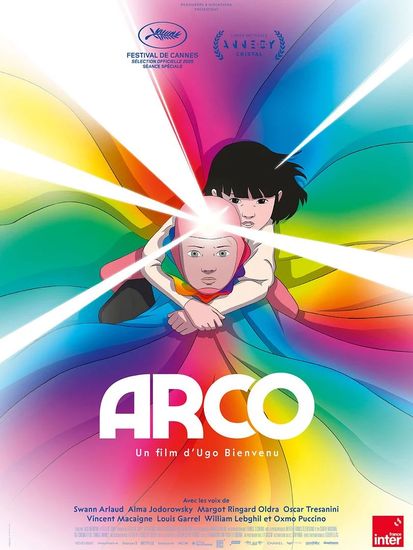
Arco Poster
Arco Diaphana
Director: Ugo Bienvenu
Screenplay: Ugo Bienvenu and Félix de Givry
Production: MountainA, Remembers
Distribution: Diaphana
International Sales: Goodfellas Animation
Release Date: October 22, 2025
Select Support from the CNC: Animation Technique Grant (ATA), Feature Film Development Grant, Author’s Path Grant 2021, Genre Film Grant, Original Music Creation Grant, Selective Video Publishing Grant (2025 program), Selective Distribution Grant (2025 program)
熱門頭條新聞
- Apple Completes App Store Leadership Transition; New Management Pursues Higher Margins, Phil Schiller Steps Back From Day-to-Day Operations
- Apple’s new EU App Store Business Terms Still Violate the Digital Markets Act (DMA).
- Lost and Found Co. Developer Bit Egg Becomes First Game Studio to Win Thailand’s Prestigious Prime Minister’s Export Award
- DRAGONHEIR: SILENT GODS MARKS THIRD ANNIVERSARY WITH COMMUNITY-CREATED HERO AND ORDER VS. CHAOS SHOWDOWN
- China Domestic Animation Summer Season 2026 Review: Box-office Boom for Theatrical Animation, Established Web Series Face Headwinds, AI Man-Dramas Explode for New Growth
- Tianji: Shadow of the Ancients, Coming 2027 to Multiple Global Platforms
- China’s Anime-Goods (“Guzi”) Economy 2026 Market Review
- Newzoo Forecasts Global Games Market to Hit $213.9 Billion by End-2026