2D CAD market stays structurally strong
Global 2D CAD market dynamics and structural shifts.
2D CAD never left; it just stopped grabbing headlines. The market sits at about $5.4 billion in 2025 and keeps growing as a distinct layer alongside 3D tools, not underneath them. ISVs, silicon teams, and CIOs still meet most day to day work in 2D drawings, not shiny models. The economics tell a clear story: Margins stay richest at the top, the long tail survives on shared infrastructure, and AI shows up as quiet productivity, not disruption.

2D CAD and 3D CAD now run as separate disciplines, and that split defines how vendors, ISVs, and IT teams plan the next decade. 2D CAD represents designs as lines, arcs, dimensions, and annotations; it delivers the actual documents that jobs depend on—permit sets, construction drawings, fabrication details, patent illustrations. Contractors, machinists, inspectors, and regulators work from 2D outputs because those drawings match how work gets approved and measured on-site and in the shop. 3D CAD handles assemblies, systems, and building models, but in most workflows the 3D model still produces 2D drawings downstream. A long list of disciplines—light AEC, basic MEP, civil site layouts, 2D only fabrication shops—never touch a 3D model at all. 2D CAD, therefore, remains a live, independent market, not a leftover waiting for replacement.
The price structure reinforces that split. 2D CAD average selling prices land around $500 to $900 per seat per year; it behaves as a commoditized drafting tool with wide adoption. 3D CAD sits closer to $2,500 to $4,000 per seat per year, tied to heavier engineering and manufacturing workloads. Autodesk AutoCAD LT comes in nearly $500 per year. DraftSight Professional starts at $299 per year. Full AutoCAD, used heavily for 2D workflows, runs roughly $2,095 to $2,310 per year. Dassault Systèmes SolidWorks standard licenses list around $2,820 per year, rising above $4,700 per year at premium tiers, a reasonable anchor for mainstream mechanical 3D. Working ASP converges near $700 for 2D versus about $3,200 for 3D. 2D still carries more seats; 3D captures more dollars per seat and more incremental growth.
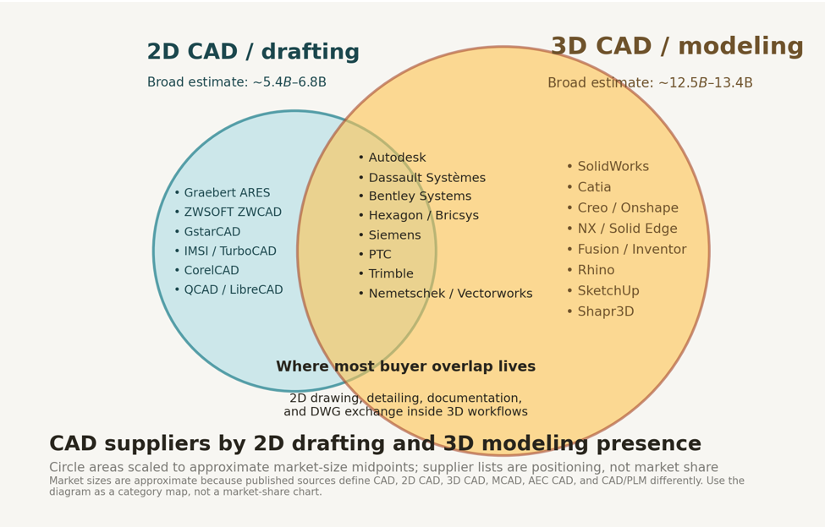
Figure 1 shows CAGR through 2035, while JPR uses a more conservative $5.4 billion 2025 base.
Figure 1. 2D and 3D CAD markets overlap through major suppliers that serve both drafting and model-based design workflows, but the two segments remain structurally different. 2D CAD retains a broad drafting base and lower ASP, while 3D CAD captures more revenue through higher-value mechanical, AEC, simulation, and product-development seats.
Supplier structure layers economics on top of those usage patterns. Autodesk holds the largest 2D CAD share and runs gross margins above 90%. Bentley sits second at about 9.7% share and also operates at major vendor margin levels. Roughly 62% of the market stays effectively locked inside a top group of direct sales majors—Autodesk, Bentley, Dassault, and Siemens. That cluster delivers far more margin per dollar of share than the long tail of budget and reseller driven vendors that live closer to 35–50% gross margins. Support and localization costs stay similar across vendors; larger suppliers amortize those costs over bigger revenue bases. Smaller vendors carry those obligations against thinner income streams. A challenger that fights for share in the low margin tail confronts weaker economics before it even tackles switching costs or enterprise inertia.
One infrastructure player quietly underpins most of that long tail: the Open Design Alliance (ODA). Founded in 1998 as the OpenDWG Alliance, it now runs as a nonprofit consortium with more than 1,200 member companies. The ODA develops and maintains SDKs that read, write, and edit Autodesk’s proprietary dwg format without direct licensing. BricsCAD builds on the ODA Drawings SDK. IntelliCAD, the engine under ActCAD, progeCAD, CADian, and historically TurboCAD, traces back to ODA work as well. Autodesk itself eventually joined the alliance in 2020 after earlier legal battles over dwg branding. ODA licenses tools on tiered, royalty free terms instead of taking a cut of software revenue, so it never appears in market share or margin tables. It behaves like plumbing. Its presence makes dwg compatibility viable for small vendors that would otherwise burn development budgets before reaching a shippable release. Without ODA, much of the long tail in 2D CAD would not exist at scale.
Demand patterns track industrial composition more than raw wealth. Europe, the US, and China each contribute roughly one fifth to one quarter of the $5.4 billion 2D market. China reaches similar revenue to the US with far more seats at lower ASPs. The US and Europe reach comparable revenue totals from smaller installed bases. China alone carries about 37% of seats and 22% of revenue, landing near $430 per seat. The US sits around $1,900 per seat. Europe edges the US slightly on revenue once all 28 countries are combined.
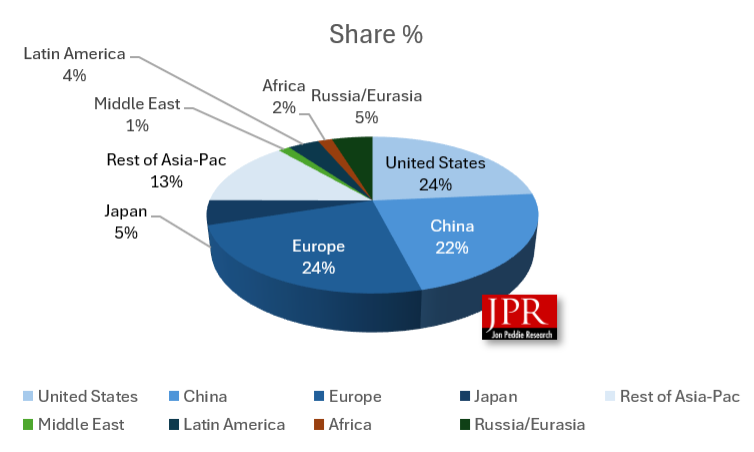
Figure 2. Regional distribution of estimated 2D CAD sales—2025 (USD millions, anchor $5,400M).
CAD intensity captures this link between industrial structure and CAD spend. Germany and Japan score highest, at 1.8 and 1.7, based on heavy auto, machinery, electronics, robotics, and shipbuilding sectors. China follows at 1.65 as the largest manufacturing base. The US lands near 1.1 because services and finance weigh heavily in its GDP. Luxembourg drops to 0.4 despite high income, thanks to its finance heavy profile and limited industrial CAD usage. Correlation between raw GDP and CAD intensity sits near 0.24, effectively flat, which confirms that CAD demand tracks industrial mix, not income level.
AI now enters the 2D CAD world through specific feature buckets. Autodesk pushes machine learning into AutoCAD with Markup Assist and Markup Import for turning handwritten or digital markups into edits, Smart Blocks for suggesting replacements from block libraries, and automatic dimension placement tuned to drafting standards and observed command patterns. DraftAid automates 2D from 3D handoffs, generating fabrication drawings from SolidWorks or Inventor models. CADGPT behaves as a CAD aware copilot, generating AutoLISP or Python to script repetitive tasks. BricsCAD maps standard 3D geometry into BIM elements. Legacy drawing digitization tools convert scanned blueprints and old PDFs into structured vector drawings that teams can edit and reference. Vendors quote numbers like 94% accuracy or hours saved per day, but most of those figures come from marketing and trade blogs and need cautious treatment. AI in this segment shows up as embedded productivity inside existing seats, not as an external product that rewrites market share. 2D CAD remains the drafting and documentation layer that many workflows never leave, supported by ODA plumbing and enhanced—not replaced—by AI inside the familiar tools.
For ISVs, silicon teams, and CIOs, the implication stays clear. 2D CAD holds a large, sticky installed base with strong margins concentrated at the top, a resilient long tail anchored by shared infrastructure, and AI that arrives as workflow acceleration rather than displacement. Planning product roadmaps or fleet refreshes means treating 2D CAD as a durable core workload with its own price bands, intensity patterns, and AI adoption curve, not as a temporary stop on the way to an all 3D future.
What do we think?
The real tension here sits between margin structure and market access, not between 2D and 3D. Autodesk and Bentley compound advantage through 90% class margins, while the long tail fights with thinner economics against the same support and localization burden. ODA quietly keeps that tail alive. For ISVs and CIOs, those economics matter more to strategy than any 2D versus 3D narrative.
Inflection point
AI inside 2D CAD hints at an inflection point, but it does not announce a sudden break. The current wave pulls tedious markup, dimensioning, and digitization work into automated flows while human judgment stays in charge. If tools like DraftAid and CADGPT reach audited productivity gains at scale, that outcome signals a real inflection point where AI starts shifting seat counts and upgrading timing, not just easing workflows. ISVs and CIOs should watch those metrics, not the headlines.
About Jon Peddie Research
Jon Peddie Research has been active in the graphics and multimedia fields for more than 30 years. JPR is a technically oriented multimedia and graphics research and consulting firm. Based in Tiburon, California, JPR provides consulting, research, and other specialized services to technology companies in various fields, including graphics development, multimedia for professional applications and consumer electronics, high-end computing, and AI processors. JPR’s Market Watch is a quarterly report focused on PC graphics controllers market activity for notebook and desktop computing.
Source:Jon Peddie/Jon Peddie Research
熱門頭條新聞
- Studio Ghibli Fest 2026 Kicks Off Nationwide U.S. Theatrical Run, Castle in the Sky Returns for Historic 40th Anniversary Screening
- Full Winners List Unveiled for the 53rd Student Academy Awards, Diverse Works Highlight Global Young Filmmaker Voices
- 2D CAD market stays structurally strong
- Award-Winning Studio Behind Boxville Reveals I Want to Play the Villain!
- Full Industrial Chain Globalization Reshapes the Development Landscape of Chinese Animation
- Global Top-Grossing Mobile Games in H1 2026: Honor of Kings Tops List with Over $1 Billion Revenue, Chinese SLGs Secure Top Three Spots
- Blockbuster Korean Webtoon IP Tomb Raider King to Adapt into TV Anime, Setting New Benchmark for Global Korean IP Development
- VS Animation! Returns to Montevideo for Ventana Sur 2026;